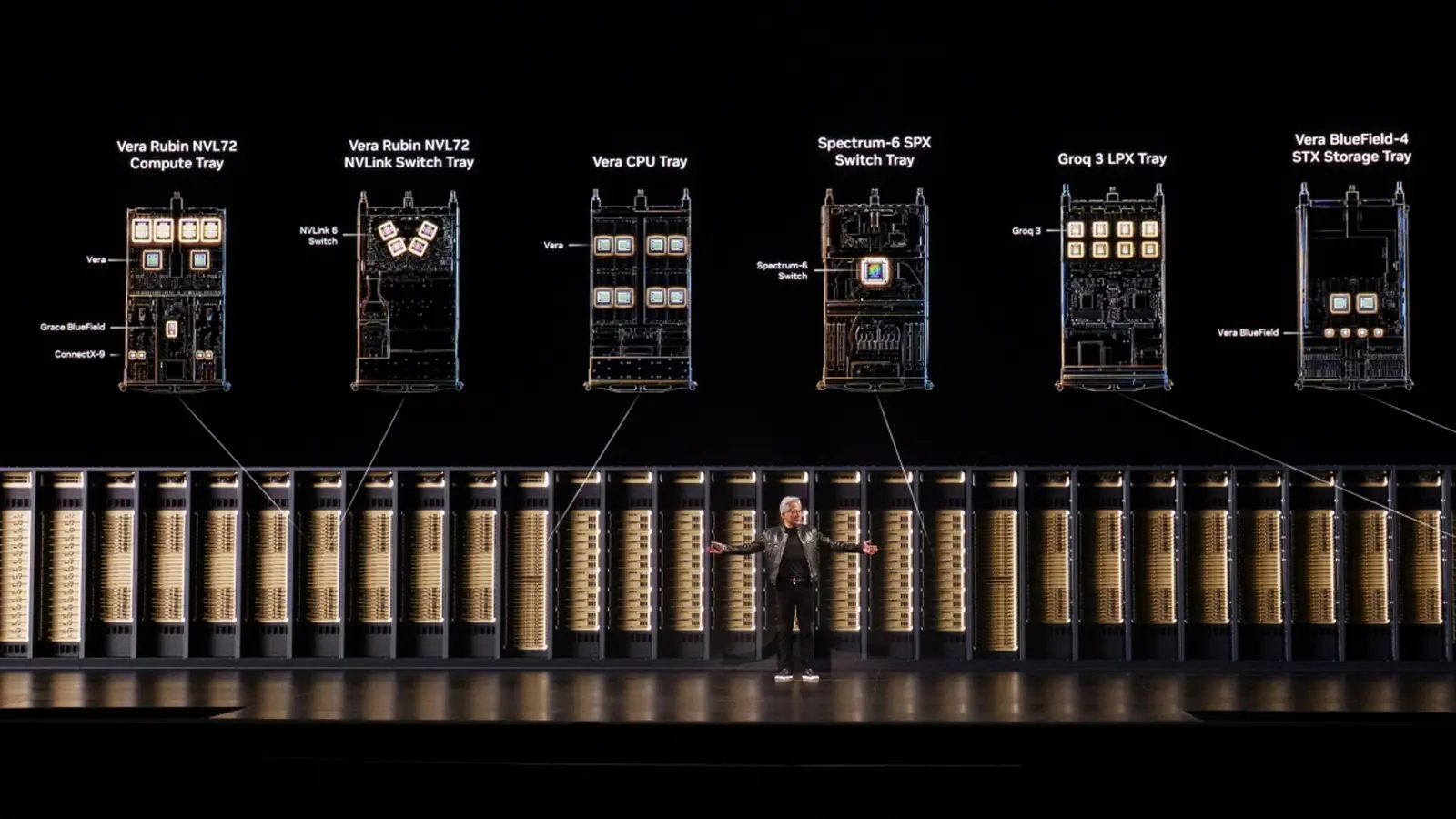
NVIDIA says its Vera CPU runs AI agent workloads faster than the fastest x86 processor while fitting 1.6x more agents into the same power budget. The company published the claim on November 5, 2026, with results from six partner companies.
The pitch is aimed at data center operators who are limited by electricity rather than floor space. NVIDIA argues that one Vera chip can replace the mix of fast and dense x86 parts that providers use today to balance speed and capacity.
Why do AI agents need CPUs?
AI agents lean on CPUs for every step that is not model reasoning. According to NVIDIA, agents search for information, query databases, write and test code and take action, moving between GPU reasoning and CPU execution throughout a task.
As more businesses run agents, the CPU side has to execute those steps quickly and handle many agents at once. NVIDIA calls the sites that do this work AI factories and says they are power limited, so the goal is the most work for every watt.
How does Vera compare with x86 chips?
NVIDIA ran a comparison for a 100-megawatt data center and says a single Vera CPU beat both the fastest x86 CPU and the most energy-efficient x86 CPU. These are the company’s own figures:
- Versus the fastest x86 CPU: industry-leading agent speed and 1.6x more agents per watt
- Versus the most energy-efficient x86 CPU: 2x faster agent speed with leading energy efficiency
NVIDIA does not name the x86 models in the announcement, so readers cannot yet match the claim to specific Intel or AMD parts.
What are early customers reporting?
NVIDIA lists six partners with production-style tests, and each result comes from the company’s own post:
- Perplexity ran agentic coding tasks 1.5x faster than on traditional CPUs and plans to deploy Vera in an upcoming production system.
- DeepInfra reached up to 2.2x the speed of the best x86 processor on agentic orchestration for its production agent workload.
- ClickHouse scaled its standard binary, with no Vera-specific tuning, near-linearly across 176 cores and topped the ClickBench hardware leaderboard.
- DuckLabs measured about 1.5x the median TPC-H SF1000 performance of an Intel Xeon 6 baseline.
- Daytona brought 1,000 agent sandboxes online in 10.8 seconds, compared with 88.4 seconds on x86, and reached 12.7 completed jobs per second at 2,000 concurrent sandboxes.
- Modal saw up to 2x sandbox throughput per core against comparable x86 hardware, with gains that grow under heavy load.
DeepInfra also published its own write-up in July 2026. It replayed captured traffic from a live agent on early-access Vera hardware and reported that Vera sustained 256 concurrent agents in a 20-core partition, against 160 for the incumbent chips it tested. Because DeepInfra both runs the platform and ran the test, treat it as a vendor result.
What does Vera cost and where can you get it?
The announcement gives no price, no list of server makers and no shipping date for Vera. It is a data center processor, so regular readers will not buy it directly. Pricing for servers built on it would come from cloud providers and system builders, and NVIDIA has not named them here.
Who it suits
AI infrastructure providers. The case is a single CPU for many agent workloads, so operators sizing a power-limited site have a new option to test against their current x86 racks.
Companies running coding agents or sandboxes. The Perplexity, Daytona and Modal figures all concern sandboxes and agent tasks, which is closest to what these teams run.
Database and analytics teams. ClickHouse and DuckLabs results suggest Vera is also being tried on query workloads, though both are single benchmarks.
Who should wait. Anyone planning a purchase should hold off until independent tests appear, since nearly every figure so far comes from NVIDIA or its partners.
What is still unknown?
The announcement does not give the exact x86 chips used, the test settings behind the 100-megawatt comparison, Vera pricing or when servers ship. It also does not say whether the partner results will hold in other setups.
What to do next
Read the NVIDIA Vera CPU page linked from the announcement, and watch for independent benchmarks that name the x86 chips and workloads used.