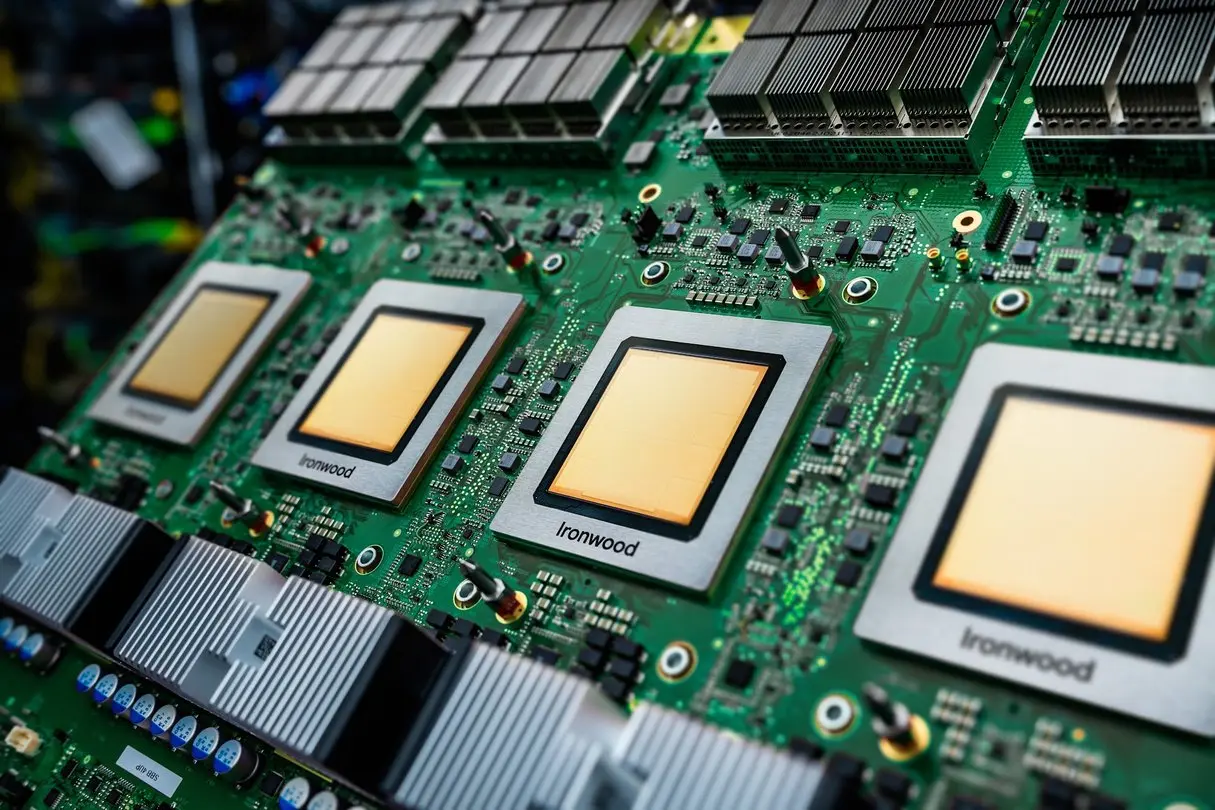
Google Cloud says 8,192 of its seventh-generation Ironwood TPUs reached the target quality in the MLPerf Training v6.1 pre-training benchmark in 1.70 minutes. The company published the result on November 16, 2026, along with entries on NVIDIA Grace Blackwell GPUs and on the first MLPerf benchmark for agentic reinforcement learning (RL).
For anyone renting AI hardware, the numbers show what Google’s cloud can do at scale. In total, Google Cloud published 10 results in this round, all in the Closed division of the benchmark run by MLCommons.
What did Google Cloud submit?
Google says the entries span frontier pre-training and agentic RL, and run on its AI Hypercomputer architecture. It describes the results as co-design across silicon, networking and open software.
- Pre-training on Ironwood: 8,192 Ironwood TPUs reached the target quality in 1.70 minutes
- Agentic RL on Ironwood: 640 Ironwood TPUs
- Pre-training on NVIDIA GB300: 256 GPUs on A4X Max instances reached the target in 31.96 minutes
- Agentic RL on NVIDIA GPUs: five submissions on A4X and A4X Max instances
The result list in Google’s footnote shows the pre-training entries ran DeepSeek-V3 on 2,048, 4,096 and 8,192 Ironwood chips, and on 256 GB300 GPUs. The agentic RL entries used Qwen3.5-397B on Ironwood and on 56, 64 and 256 NVIDIA GPUs.
How well does it scale?
Scaling is the part Google stresses. It says pre-training scaled up to 4,096 chips with 96% efficiency. That matters because adding chips only shortens training if they spend their time computing instead of waiting on each other. Google does not state the efficiency at 8,192 chips, so treat the 96% as the figure for the 4,096 chip run.
For context, MLCommons says 12 systems in this round used 1,000 or more accelerators, and the largest used 10,240. NVIDIA reported a 10,240 GPU DeepSeek-V3 run on GB300 systems, which makes 8,192 Ironwood chips a large run by this round’s standards.
What is the agentic RL benchmark?
Agentic RL trains a model by letting it write code and then learn from the outcome. The benchmark is Qwen3.5-397B, which MLCommons describes as the first post-training workload in the suite, trained with Group Relative Policy Optimization to reason through software engineering tasks, including tool calling.
Google says 640 Ironwood TPUs reached the coding target accuracy in 18.02 minutes, scoring 0.765 against a goal of 0.69. It adds that code generation and learning ran at the same time, so the training chips waited under 3% of the time. Idle chips are wasted money in this kind of workload, so that figure is the one cloud buyers should read closely.
How much does it cost?
Google lists no price in this announcement. Ironwood TPUs and A4X and A4X Max instances are Google Cloud services, so pricing and availability depend on the region and contract. Check the Google Cloud pricing pages or ask a Google Cloud sales contact for your country.
Who it suits
Teams training very large models. The pre-training results show Google can run thousands of TPUs together, which matters if your job needs that many chips.
Teams building coding agents. The RL result, with chips idle under 3% of the time, speaks to a workload that is spreading. Treat it as a single benchmark, not a guarantee for your own code.
Customers who prefer NVIDIA. Google also entered GB300 and GB200 systems, so you can stay on that stack within Google Cloud.
Who should wait. Anyone choosing a provider on these results alone. They show one model per category, and the sources here do not compare Google with other vendors.
What is still unknown?
Google’s post does not give prices, regional availability, or how the TPU and GPU entries compare with each other. The MLCommons results page lists 153 systems from 24 organizations, so it is the place for side by side checks. MLCommons also says this round brought the first results for Google TPUv7 (Ironwood) and for NVIDIA Rubin-generation GPUs.
Read Google’s post for the result IDs, and the MLCommons Training v6.1 page to compare submissions.