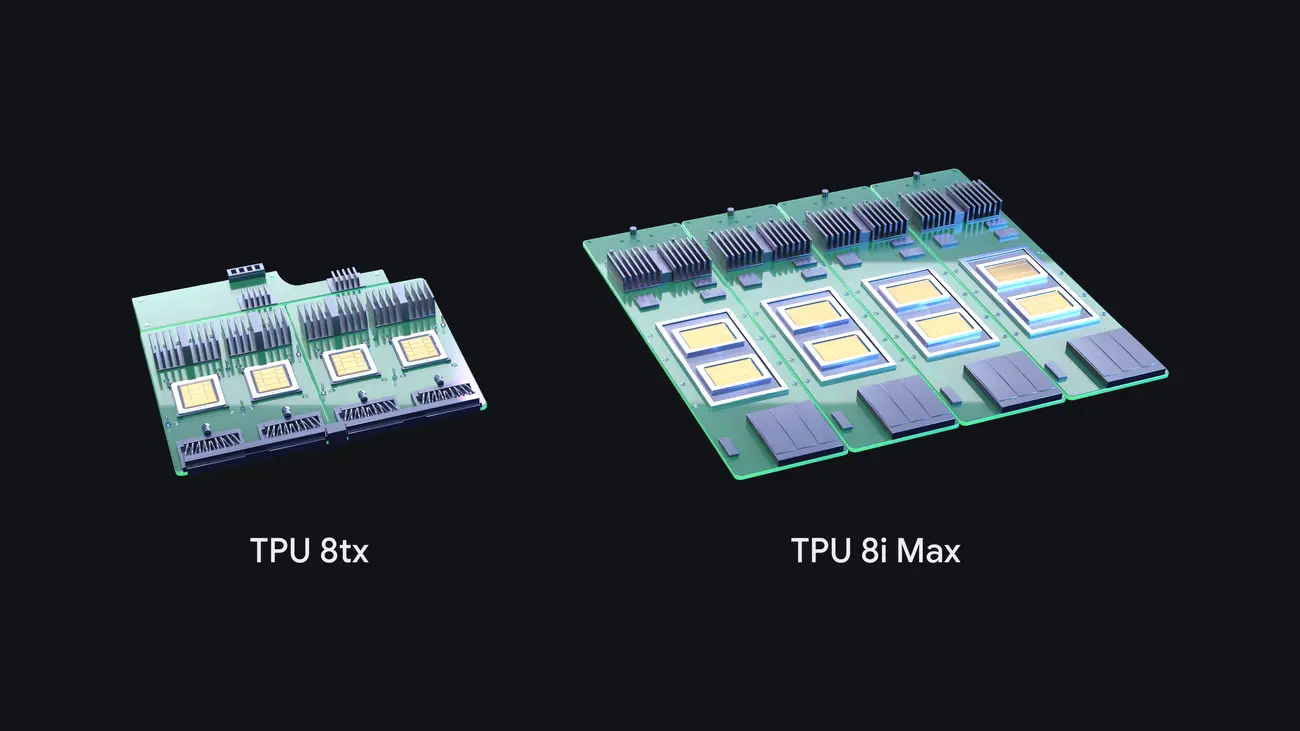
Google has added two systems to its eighth-generation TPU family: TPU 8tx, built for secure and confidential inference, and TPU 8i Max, built for very large context windows. The company announced them on November 9 and says it is the first time it has introduced four TPU systems in a single year.
TPUs are the custom processors Google designs for AI work. They are not a gadget you can pick up in a shop, and most readers will meet them indirectly, through cloud services and apps that run on them. They still decide how fast, how private and how affordable those services can be.
What are the four systems in this generation?
Google first showed TPU 8t and TPU 8i at Google Cloud Next in April. The two new systems are variations built on the same foundations.
- TPU 8t: training of large foundation models
- TPU 8i: low-latency, real-time reasoning
- TPU 8tx: secure and confidential inference, also suited to small-scale training
- TPU 8i Max: massive context windows and the highest compute density per rack
For the first two, Google claims up to 2.7 times better training performance (8t) and 80% better inference price performance (8i) than the previous generation. It also says 8i cuts inter-chip communication delays by up to half.
What does TPU 8tx do?
TPU 8tx is aimed at regulated companies and governments that run sensitive data through frontier or proprietary models.
- Built on the same silicon as TPU 8t
- Paired with 5th Generation AMD EPYC CPU hosts
- Uses the low-latency Boardfly network first created for TPU 8i
- Up to 2x lower latency than TPU 8t with a near-zero performance penalty, according to Google
Data is normally encrypted in storage and on the network, but has to be unlocked in memory while a computer works on it. Google says 8tx builds protection into the hardware, so sensitive data and model weights stay isolated even while in use. Because it combines training-grade compute with a fast network, the same system can run a model and customize it.
What does TPU 8i Max do?
TPU 8i Max puts two TPU 8i chips on a single package.
- Double the compute of TPU 8i
- Double the SRAM
- Double the HBM bandwidth
- Fits in the existing rack footprint
Google’s reasoning is that when many software agents work across a whole codebase or hours of video, memory bandwidth becomes the bottleneck. Packing twice the silicon into the same rack space means data centers can run more computing per square foot and per watt, the company says.
Is it easier for developers to use TPUs now?
Google says it has been removing barriers. Last month it open-sourced TorchTPU, so PyTorch code and Hugging Face models run natively on TPUs, and it offers backends for the vLLM and SGLang inference engines. An open-source TPU agent suite, now in preview, plugs into coding tools such as Cursor to help with onboarding and tuning. Google also open-sourced TPU Sync, which it says cuts KV transfer latency and time to first token by more than 90%, and announced an Agent Compute Engine that suspends idle agent sessions to save cost. TPUs now have nearly 100 customers, including frontier labs, trading firms, retailers and universities.
Prices
Google listed no prices and no release date for TPU 8tx or TPU 8i Max. TPUs are sold as cloud capacity, and customers can also deploy them in their own data centers, so there is no retail price. For the earlier 8t and 8i chips, TechRadar reported that general availability for Google Cloud customers was expected in the coming months.
Who it suits
Regulated organizations. Banks, health groups and public bodies that must keep data protected while a model processes it are the target for TPU 8tx.
Teams working with long context. Companies running many agents over large codebases or long video are the use case for TPU 8i Max.
PyTorch developers. TorchTPU means existing code and Hugging Face models can run on TPUs without a rewrite, according to Google.
Everyday readers. You will not buy these chips, but they may sit behind the cloud tools you use, so faster and more private back ends could show up later as better services.
What is still unknown?
Google did not give a launch date, regional availability or pricing for the two new systems, and it published no benchmark figures for them against rival hardware. Watch the Google Cloud infrastructure pages for those details.