NVIDIA used the Conference on Robot Learning (CoRL) in Austin, Texas, to introduce GR00T 2, a robot model, along with Isaac Lab 3.0 and two new open benchmarks. All of it targets the same problem: teaching robots fine tasks such as aligning gears, connecting cables and assembling small parts, mostly by practising in simulation first.
The tools are for researchers and companies, not shoppers, but they show how the robots of the next few years are being trained. The announcement was published on November 9.
What is GR00T 2?
GR00T 2 is described by NVIDIA as an open world action model built on NVIDIA Cosmos. It was trained on robot and human data, including 100,000 hours of NVIDIA open source human egocentric data.
- Completed 40 of 50 evaluated tasks at least once without task-specific demonstrations
- Learns from human demonstrations and transfers skills between different robot bodies
- 71% average success across 50 tasks with one demonstration per task, rising to 95% with five
- Agents can call its programming interface to run skills in sequence and recover from errors
NVIDIA says it ranks among the top three models in several benchmark categories, including RoboCasa365, RoboLab, RoboDojo and MolmoSpaces. Nexuni is testing it for laundry handling, Foxconn for server manufacturing and Siemens across industrial uses. These are the company’s figures, not independent tests.
What is new in Isaac Lab 3.0?
Isaac Lab is NVIDIA’s open source robot-learning framework. Version 3.0 lets researchers use agents to set up training environments, switch between the PhysX and Newton physics solvers, choose renderers for perception-based training and apply a reinforcement post-training library to models like GR00T.
- Tighter Newton integration, so cables, cloth and robotic hands with many joints can be modeled
- Thousands of simulated robots trained in parallel
- Up to 2.5x the training throughput of Isaac Lab 2.3 with PhysX in a vision-based dexterous manipulation benchmark
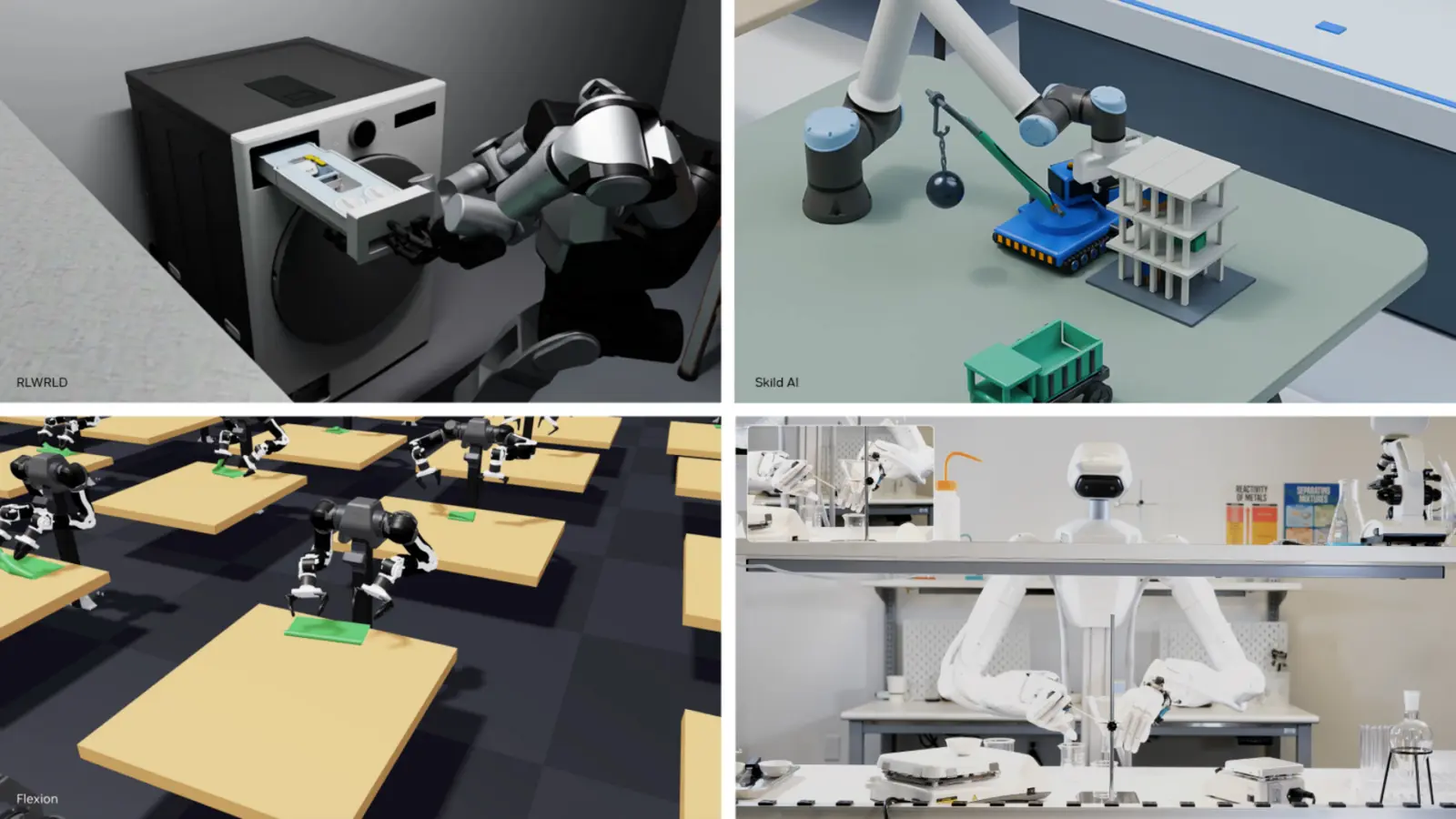
Newton is an open source physics engine that, according to earlier coverage, was co-developed by Google DeepMind, Disney Research and NVIDIA and is managed by the Linux Foundation. Skild AI announced STEEL, a rigid-body solver built on Newton, and Flexion, FieldAI, Dyna Robotics, Walden Robotics and Dexmate described their own simulation work.
How precise can simulated practice get?
NVIDIA points to AlphaNIST, built in Isaac Lab. A single policy learns all 20 tasks on the NIST Assembly Task Board, handling millimeter-scale parts with only a yes-or-no success signal. It reached more than 98% training success, against 81% for separate per-task policies, using roughly 39x less GPU time. The method behind it, Success-Guided Sampling from the University of Washington and NVIDIA, focuses practice on tasks a policy gets right about half the time, and NVIDIA says it can scale beyond a million parallel environments.
What are the new benchmarks?
Isaac Lab-Arena, an open source evaluation framework, reaches developer preview in version 0.4. Two benchmarks use it:
- DexBench, from RLWRLD with NVIDIA: 15 tasks across four scenes covering retail, logistics, manufacturing and hospitality
- VABAR, from UC Berkeley and NVIDIA: six industrial tasks with standardized variations, difficulty tiers and success metrics
UC Berkeley’s Graph-as-Policy framework uses agents to link skills into programs that engineers can review before deployment. NVIDIA also released a Video to Data workflow and the EgoHand model, which it says passed 40,000 Hugging Face downloads in two weeks.
Prices
NVIDIA’s post lists no prices. The tools are described as open, and Isaac Lab-Arena 0.4 is a developer preview. NVIDIA does not say where each piece can be downloaded in this post, so check its developer pages.
Who it suits
Robotics researchers. Open models, simulators and benchmarks give labs a shared way to train and compare dexterous skills.
Factory and warehouse teams. Foxconn, Siemens and others are testing the work for assembly, logistics and similar jobs, though none of it is described as a finished product.
Students. The University of Texas at Austin uses Isaac Sim and Isaac Lab so students can start before hardware arrives.
General readers. Nothing here is for sale, but it hints at how future household and workplace robots may learn precise tasks.
What is still unknown?
NVIDIA gave no release dates for commercial use, no pricing, and no independent verification of its benchmark claims. Most results come from simulation or lab demos, so how well they carry over to real factories remains to be shown. The NVIDIA blog post has the full list of partners and links.