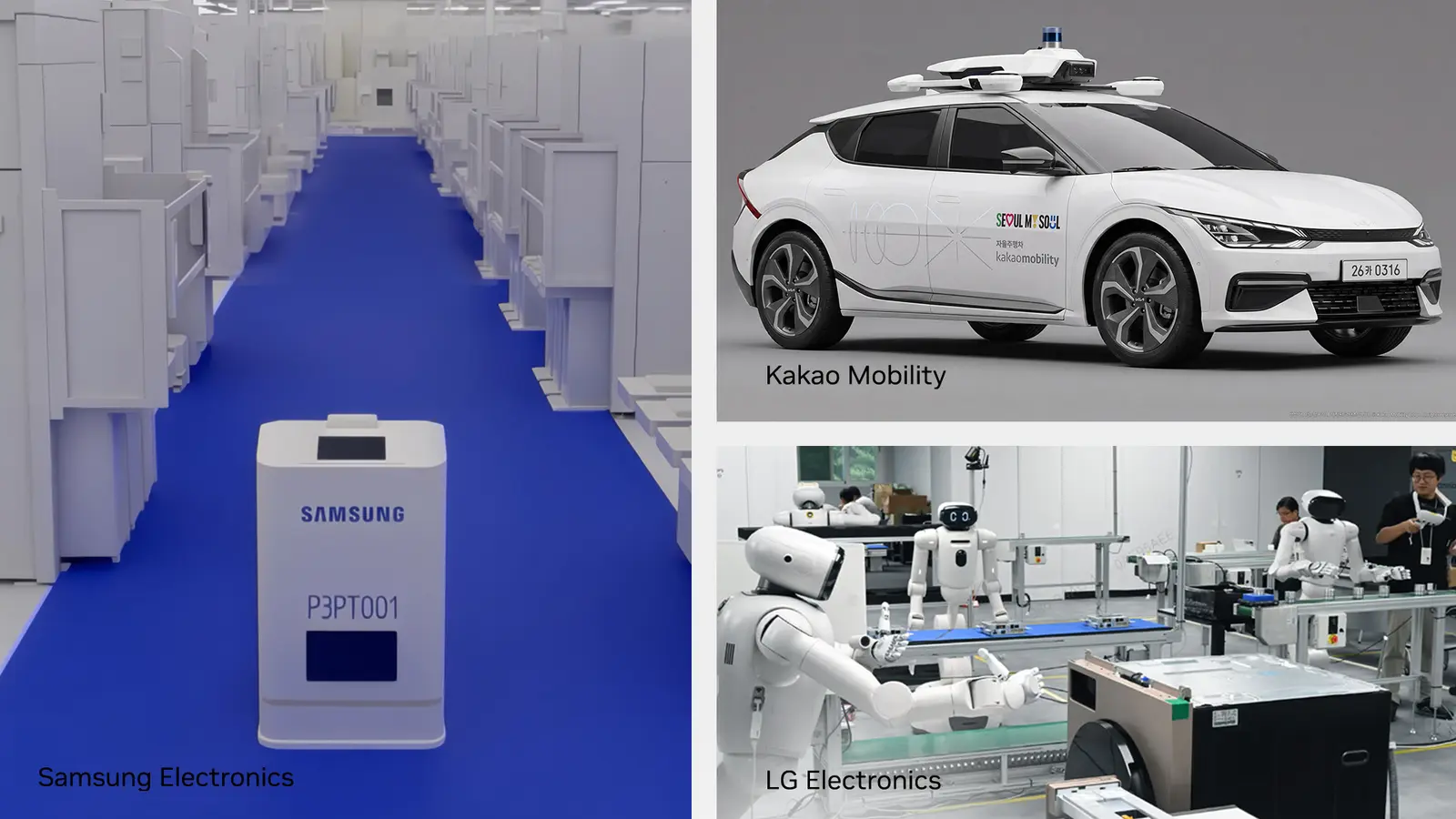
NVIDIA says Samsung, Kakao Mobility and LG Electronics are putting its chips and software to work in Korean chip design, self-driving cars and factory robots, with one Samsung simulation dropping from about 18 hours to 41 seconds. The details come from an NVIDIA blog post published on November 8, 2026.
What is Samsung doing with NVIDIA?
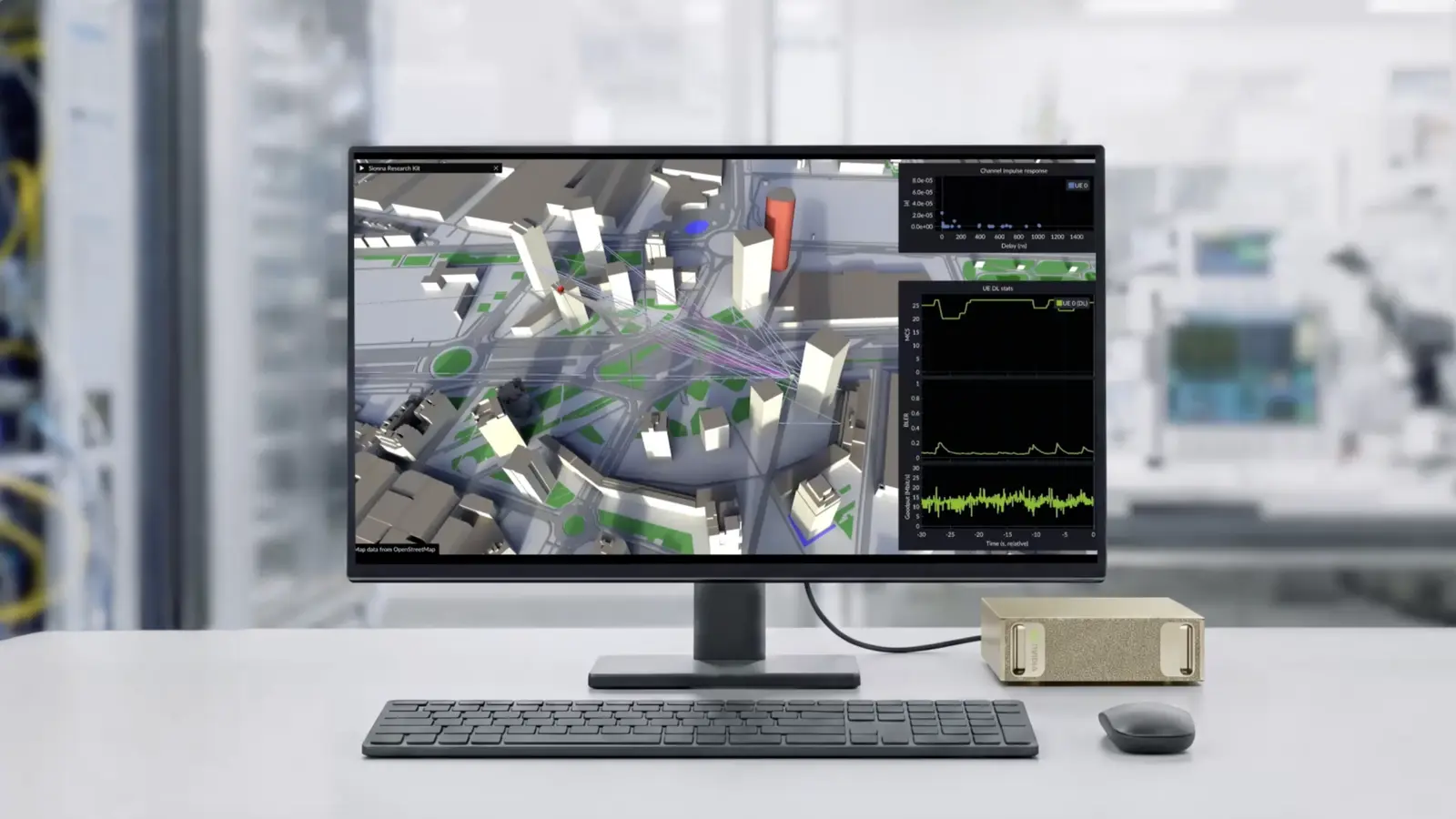
Samsung Electronics is using accelerated computing and AI physics across materials research, process development and device engineering. In technology computer-aided design, it works with NVIDIA cuISS and NVIDIA cuDSS to speed up calculations on sparse linear systems, and it also uses GPU acceleration for process and optical simulations.
NVIDIA reports these figures:
- Samsung’s sMOL platform ran selected quantum chemical calculations up to 5x faster end to end with NVIDIA cuEST.
- In one chip-scale thermal and mechanical case built with NVIDIA PhysicsNeMo, AI-predicted material properties, coarser grids and GPUs gave a roughly 1,600x speedup.
- That case fell from about 18 hours for a fine-grid solve on a 32-core CPU to 41 seconds.
Samsung is also exploring NVIDIA cuEquivariance for tensor operations used in atomistic AI models. These are NVIDIA’s figures for selected cases, not a general benchmark.
What is Kakao Mobility building?
Kakao Mobility plans to develop a level 4 autonomous driving system on NVIDIA Hyperion, a reference platform for vehicle sensors and compute powered by NVIDIA DRIVE AGX Thor. It also plans to use NVIDIA Halos to support safety during development and validation.
Initial development is planned around Kia purpose-built vehicles. The software combines Kakao Mobility’s own driving stack and its experience operating in Seoul’s Gangnam district. The stated aim is future level 4 mobility services in Korea. No launch date is given.
What did LG Electronics demonstrate?
NVIDIA and LG Electronics demonstrated robotic manipulation and manufacturing tasks with LG’s CLOiD robot in a real manufacturing environment, powered by NVIDIA Isaac GR00T.
The workflow links real-world data collection, NVIDIA Cosmos data augmentation, GR00T model training, NVIDIA Jetson AGX Thor onboard computing and simulation-based evaluation. NVIDIA says the point is a repeatable way to train, test and improve robots for factory work.
Prices and availability
None of the three projects lists a price or a public release date. These are engineering collaborations with industrial partners, so there is nothing for consumers to buy.
Who it suits
Chip and materials engineers. The Samsung numbers show where GPU simulation can cut turnaround time, though the 1,600x figure is for one specific case.
Mobility and fleet planners. Kakao Mobility’s plan is a development roadmap for level 4 services, not a service you can ride today.
Factory and robotics teams. The LG demo is a template for connecting data collection, simulation and training.
Who should wait. Anyone looking for a product. All three efforts are in development.
What is still unknown?
The post does not say when Kakao Mobility’s system will carry passengers, how many CLOiD robots LG plans to deploy, or whether the Samsung speedups hold across other chip designs. NVIDIA also mentions that its Agent Toolkit could one day connect simulation tools and AI models for engineering agents, but gives no schedule.
Read the original NVIDIA post for the full technical list, and the companion NVIDIA posts on Korea’s AI ecosystem for the wider picture.