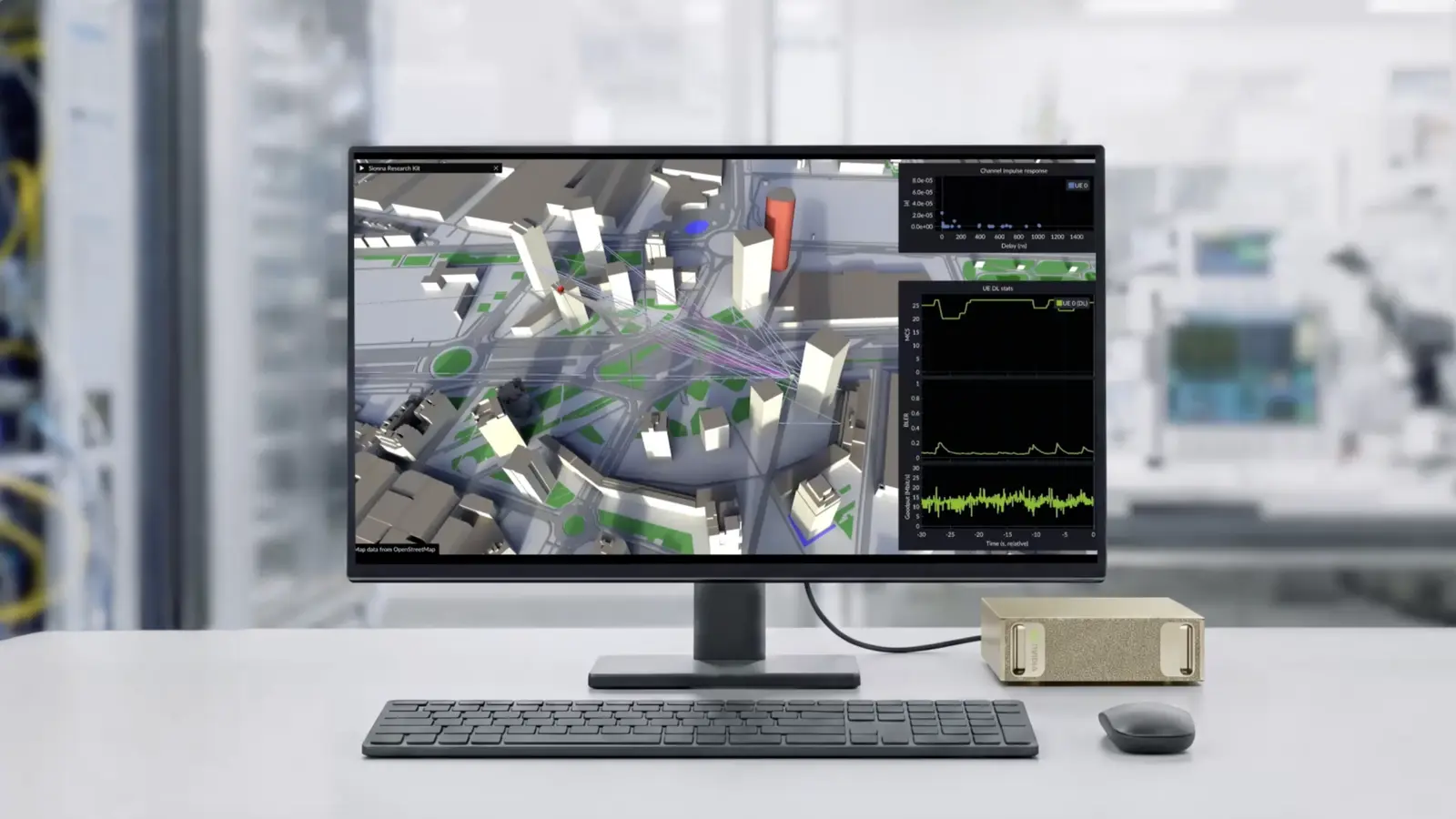
NVIDIA says its open source 5G and 6G tools have passed 1 million downloads and are used by more than 8,000 research and academic institutions worldwide. The company shared the figures on November 6, 2026, together with four research projects that show what the software is being used for.
A year ago, NVIDIA open sourced its Aerial wireless software, joining Sionna and other open tools for 6G development. NVIDIA says developer adoption of Aerial and Sionna has grown 10x over the past year.
Can a network help robots react faster?
At King’s College London, researchers connected a camera-equipped robot arm to an NVIDIA Jetson AGX Orin running Sionna, which handles both a software-defined 5G network and edge processing. Instead of sending full images, the robot sent compact descriptions of objects, their positions and their relationships.
In fruit-packing and cube-stacking tests with deliberately introduced faults, this approach cut task completion time by up to 52.6% and improved task success compared with sending periodic images, according to NVIDIA. The system could also detect dropped objects, recover from failed actions and, with a digital twin, check planned movements for collisions first.
Can a receiver decode weak signals better?
SoftBank put a neural receiver into NVIDIA Aerial CUDA-Accelerated RAN (ACAR) and tested it with a commercial 5G smartphone. In controlled tests with interference, it delivered higher uplink throughput than a conventional receiver at all 15 tested settings, with a maximum gain of roughly 60%.
ETH Zurich researchers, using NVIDIA Aerial Testbed, tuned neural receivers with local measurements and cut block error rates by more than one-third compared with selected pretrained versions.
Can a network save power without dropping connections?
A University of Leeds team built a system that predicts demand 10 minutes ahead and uses the forecast to decide which base stations can sleep. Before powering one down, it checks that neighboring active stations can still serve the affected devices, and it watches for changes that require capacity to return.
The team used a portable NVIDIA DGX Spark-powered 5G “network-in-a-box” and a digital twin to validate decisions against real wireless equipment. The researchers reported a 45.6% reduction in RAN power consumption relative to a full-power baseline while keeping devices connected.
Can network simulations run faster?
The Centre Tecnològic de Telecomunicacions de Catalunya (CTTC) brought GPU-accelerated radio channel models, running on ACAR, into its open source 5G-LENA network simulator. In an early evaluation, simulation runtime fell from approximately three hours to 10-20 minutes, depending on the integration, while keeping the expected statistical behavior and network performance.
What do the open tools include?
NVIDIA’s earlier announcement said Aerial includes Aerial CUDA-Accelerated RAN, Aerial Omniverse Digital Twin and a new Aerial Framework, released under the Apache 2.0 license on GitHub. At that point Sionna had passed 200,000 downloads. NVIDIA says both Aerial and Sionna are available on GitHub.
Prices
NVIDIA lists no price in this post. The software is described as open source and available on GitHub, and the earlier Aerial announcement named the Apache 2.0 license. Hardware used in the experiments, such as Jetson AGX Orin and DGX Spark, is not priced in either source.
Who it suits
University and lab researchers can reuse the tools to test ideas, compare results and build on each other’s work, since Aerial and Sionna connect simulation with experiments on real over-the-air systems.
Robotics and automation teams can read the King’s College London work as an example of how the wireless link affects response time.
Network operators and equipment makers may find the SoftBank, Leeds and CTTC results useful as early evidence on reception, power use and design testing, though all were research or controlled tests.
Students and hobbyists in wireless engineering can start from the open source code, as long as they have access to suitable hardware for the parts that need it.
What is still unknown?
The post reports research results and early evaluations, not commercial deployments. It does not say when any of these techniques could appear in a live 6G network, and the figures come from the teams’ own tests under the conditions described.
To explore the code, open the NVIDIA Aerial and Sionna repositories on GitHub. NVIDIA also says GTC Washington, D.C. will host 6G Developer Sessions with more research projects.