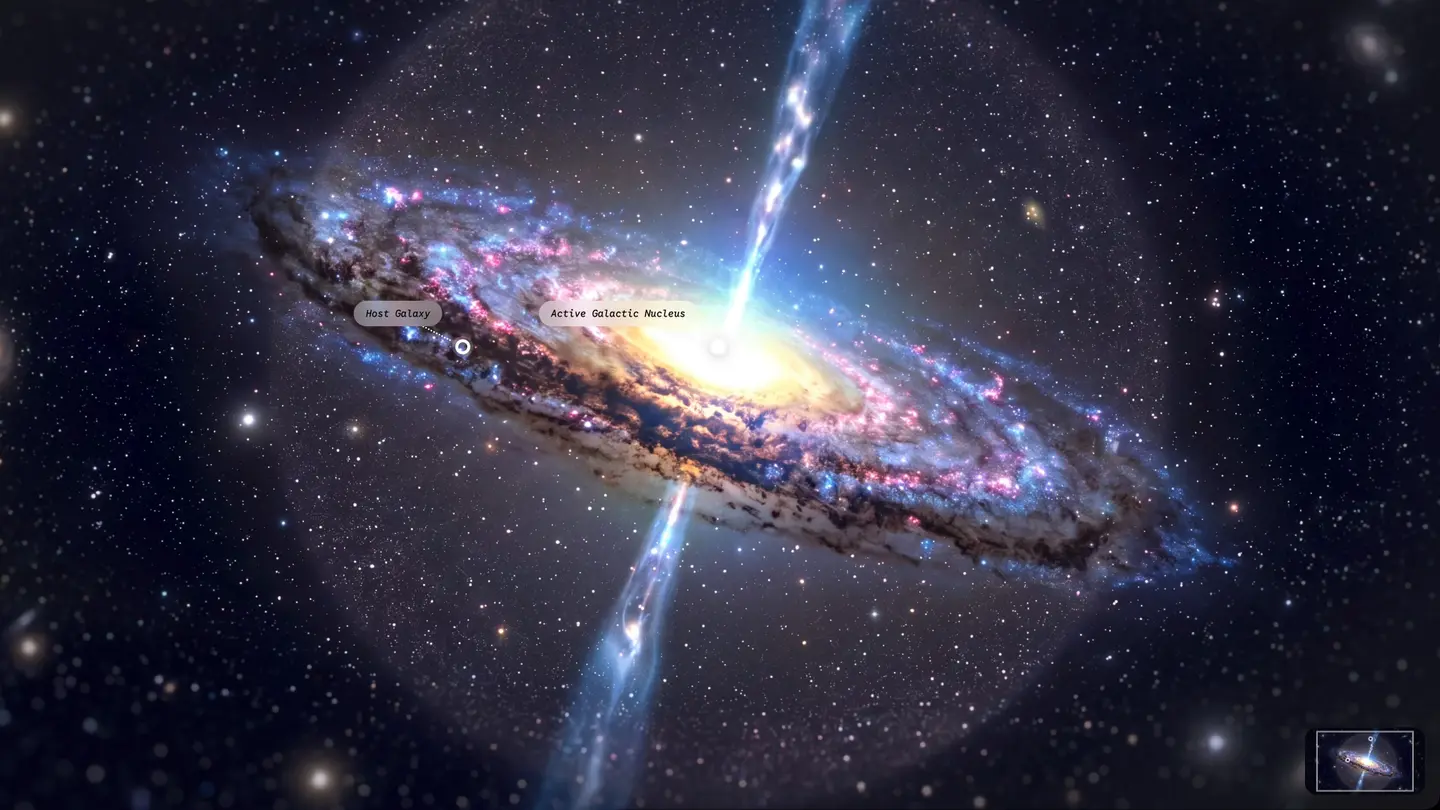
Google has added a library of immersive explorations to the Gemini app, and you can open it today from the Gemini student hub by clicking “Try immersive explorations”. Each exploration is an interactive, visual scene that you work through layer by layer, from microscopic systems to deep space.
Google published the announcement on Oct 28, 2026. It also says the explorations will soon be available directly inside a chat conversation with Gemini, so you will not have to go through the hub.
What are immersive explorations?
They are guided, visual lessons built around a single scene. Google’s examples include tracing trade routes on the Silk Road, peering inside a jet engine and studying the physics of lightning. The company describes each scene as unfolding into interactive and guided experiences.
- Interactive scenes with labels you can tap to go deeper
- Topics that run from microscopic systems to deep space
- A path that can zoom from sweeping planetary scales down to molecules and atoms
- Audio narration that Google says is coming soon, to walk you through each layer
How do you use them?
You tap a label in the scene and the exploration opens up the next layer of detail. Repeating that takes you further down, so a topic about the sky can end with something far smaller.
TestingCatalog, which spotted the feature in the Students section of Gemini in September, described it as a visual mind map. It reported that some paths run five or more nodes deep and that at least one ends at atoms and molecules. Its examples included space quasars and the dinosaur era. TestingCatalog also said at the time that it was unclear whether Google was testing the feature or rolling it out. Google’s own post now settles that: the library is live.
Which languages are supported?
Google says the feature is available to all users in six languages, and that everyone else gets an English-only version for now.
| Experience | Languages |
|---|---|
| Full experience | English, Indonesian, Hindi, Brazilian Portuguese, French and simplified Chinese |
| English-only experience | All other languages, with more languages coming soon |
Prices and availability
Google’s post does not list any price, plan or subscription requirement for immersive explorations, so we cannot say whether it costs anything. It says the feature is available to all users in the languages above.
For Canada, that means readers who use Gemini in English or French get the full experience according to the post, but Google does not name Canada or any other country. For the United States, the same applies to English. The post gives no Canadian or US dollar figure and no regional rollout dates. Check the Gemini app on your own account to confirm what you see.
Who it suits
Students and parents. The entry point is the Gemini student hub, so the feature is clearly aimed at people studying. Layer-by-layer scenes can help with science and history topics that are hard to picture from a page of text.
Curious readers. You do not need an assignment. A scene about lightning or a jet engine is a quick way to learn how something works, and you can stop at whatever depth you like.
Teachers and tutors. A guided scene with tappable labels can serve as a starting point for a class discussion. Google’s post does not describe classroom tools, so treat it as a viewing aid rather than a lesson planner.
Anyone who prefers to listen. Audio narration is promised but not live yet, so those who learn best by ear may want to wait for it.
What is still unknown
Google does not say how many explorations are in the library or which subjects will be added next. It gives no date for the in-chat version or for the audio narration, only that both are coming soon. It also does not explain how the scenes are made or how it checks them for accuracy, so treat details as a starting point and confirm important facts elsewhere.
Next step
Open the Gemini app, find the student hub and select “Try immersive explorations”. Then start with a topic you already know a little about, so you can judge how well each layer matches what you expect. Google’s announcement on its blog has the official wording on languages.