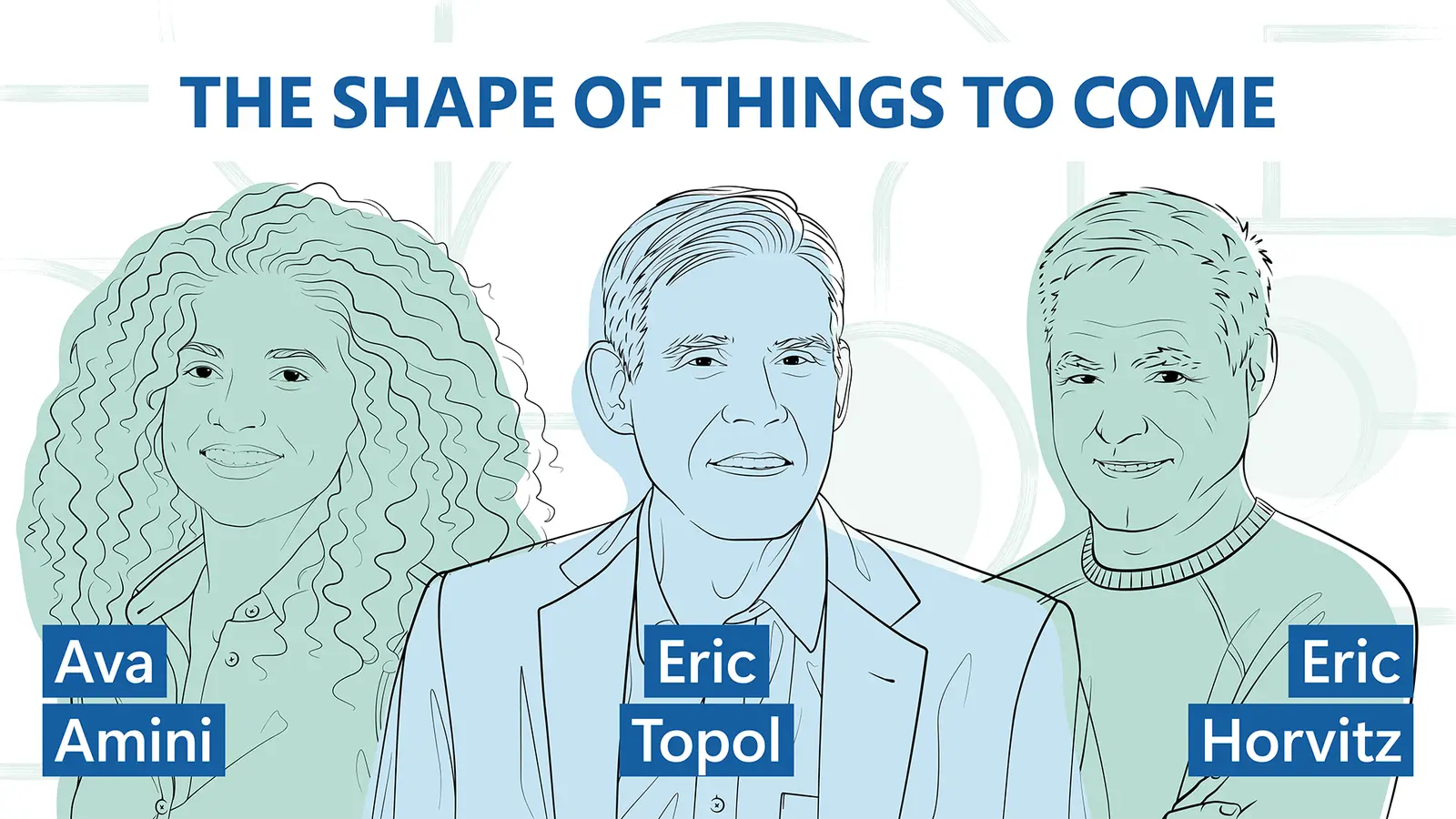
Microsoft Research published a podcast episode on November 17, 2026 that asks what medicine could look like with AI, and the guests agree on one blunt point: research is moving faster than hospitals. The episode, “Can AI help build a healthier future?”, belongs to the series The Shape of Things to Come, hosted by Doug Burger.
Three guests join him. Eric Horvitz is Microsoft’s chief scientific officer, Ava Amini is a principal research manager at Microsoft Research and co-lead of Project Ex Vivo with the Broad Institute, and Dr. Eric Topol is executive vice president of Scripps Research. Between them they cover diagnosis, medical imaging, whole-patient models, virtual cells and drug discovery.
What did the Microsoft team report on AI diagnosis?
Horvitz described a change in how diagnostic AI is tested. Instead of handing a model a finished case file, his team put it in the position of a clinician: it starts from a chief complaint and some history, then decides which questions to ask, which tests to order given their cost, and when to commit to a diagnosis even under uncertainty. He calls this the sequential diagnosis challenge.
The Microsoft Research publication page for the paper gives the headline figures:
- The AI system, which simulates a panel of physicians, reached 83.2% accuracy on New England Journal of Medicine clinicopathological conference cases
- It reached 80.3% on MIMIC-IV-ED emergency department admissions
- Generalist physicians scored 36.1 and 46.8% on the same two sets, respectively
The abstract says these results come from a controlled benchmark setting. Horvitz made a similar point in the episode, saying the comparison with human generalists has to be taken with its limits in mind. Topol called it the first agentic system to beat physicians and other frontier models on accuracy, “almost doubling” physician accuracy at lower cost.
Why does Topol say proven AI is not reaching patients?
Topol argued that the field has chased generative AI while skipping the area where deep learning is better proven: medical images such as retina scans, chest x-rays and electrocardiograms. He pointed to a randomized trial in mammography involving over a hundred thousand women and to 44 randomized trials in colonoscopy as evidence that is sitting in journals.
His explanation is about adoption, not science. Health systems work on thin margins, he said, the profession is slow to change, and neither physicians nor patients are demanding the tools. He said he is “still waiting” for that research to affect care, and suggested that pressure from physicians or patients may be what moves it.
What are whole-patient models and virtual cells?
Topol described whole-patient models as the next phase: electronic health records combined with raw images, genomics, proteomics and the exposome. The goal he set out is to predict diseases and their likely timing, test what-if scenarios, and move from telling someone they are “at risk” to enabling prevention. He expects mature whole-patient models before a virtual cell, which he said is a way off.
Amini said biology is multi-scale, from molecules to cells to organ systems, and that connecting those levels is a hard machine learning problem. Her main concern is implementation: what these models will solve and how experimental scientists will adopt them. The Broad Institute collaboration is Microsoft’s attempt to build that link from the bottom up.
What is holding AI in biology back?
Data, according to Topol and Amini. Topol noted that AlphaFold worked because the Protein Data Bank already existed, and said nothing comparable exists for life science or medicine. Amini wants activity-first datasets that map protein sequence to function at scale.
Amini and Horvitz also described using models to guide experiments, so that lab time goes to the most promising options and costs and lead times fall. Amini was direct that the real world will always be the bottleneck.
Prices
The episode page lists no price. It offers video playback, a full transcript and subscription links for Apple Podcasts, Spotify, email, Android and RSS.
Who it suits
Readers following AI in medicine. The episode gives a rare view of the Microsoft researchers and an outside physician-scientist disagreeing, agreeing and qualifying their own claims in one conversation.
Hospital and health system managers. Topol’s argument is about adoption barriers such as cost, margins and incentives, which is more practical than another benchmark result.
Students and researchers in biology and machine learning. The data and validation discussion shows where the field says its next gains must come from.
Anyone looking for health guidance. This is a discussion of research, not medical advice. For questions about your own health, speak to a qualified clinician.
What is still unknown
The episode does not give a date for when any of these systems could be used in clinics, and the paper’s results are benchmark results. The guests themselves say implementation, better biological data and real-world validation are still missing.
To go further, open the episode page on the Microsoft Research site for the transcript, then read the paper’s publication page for the full abstract.