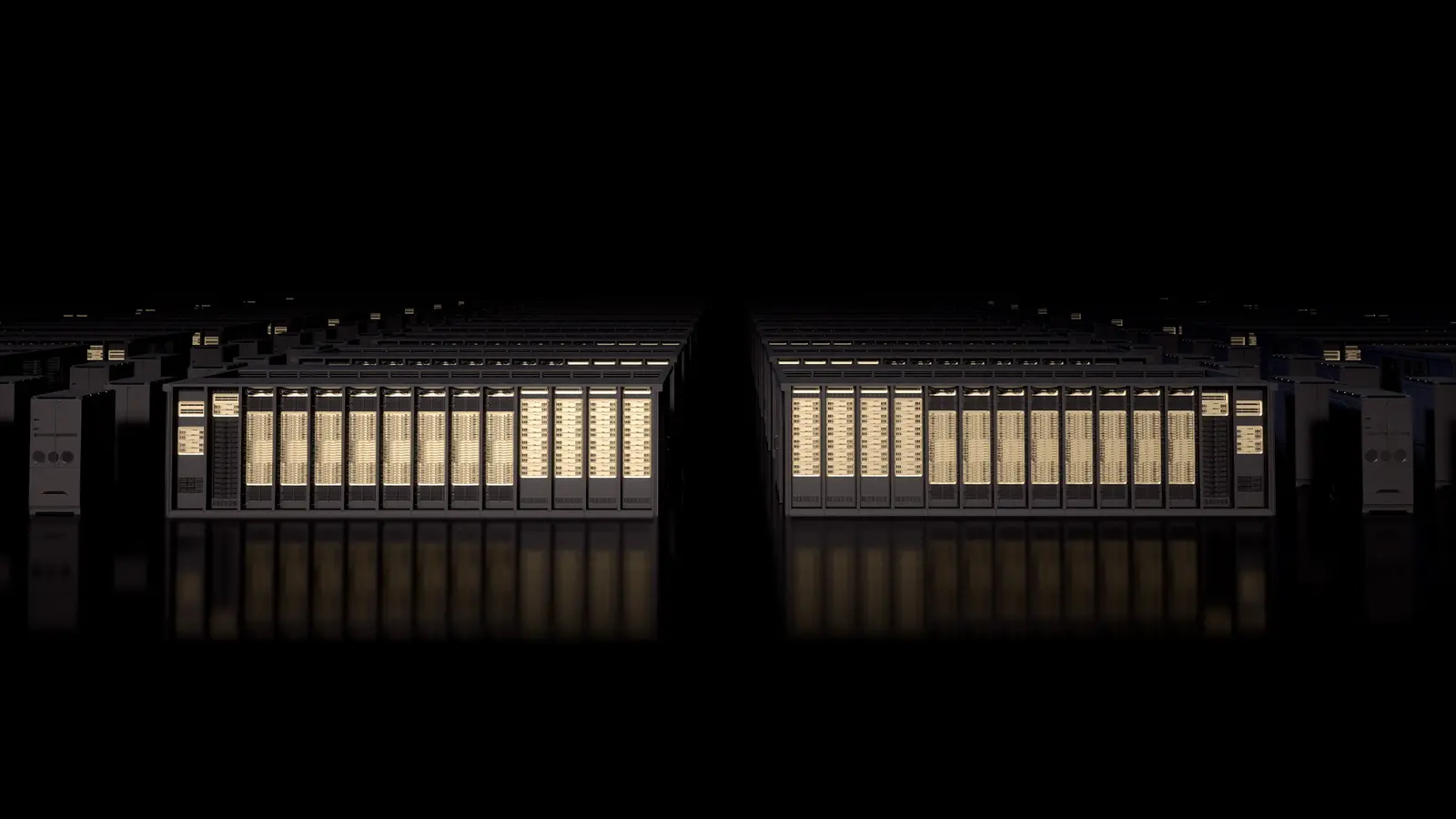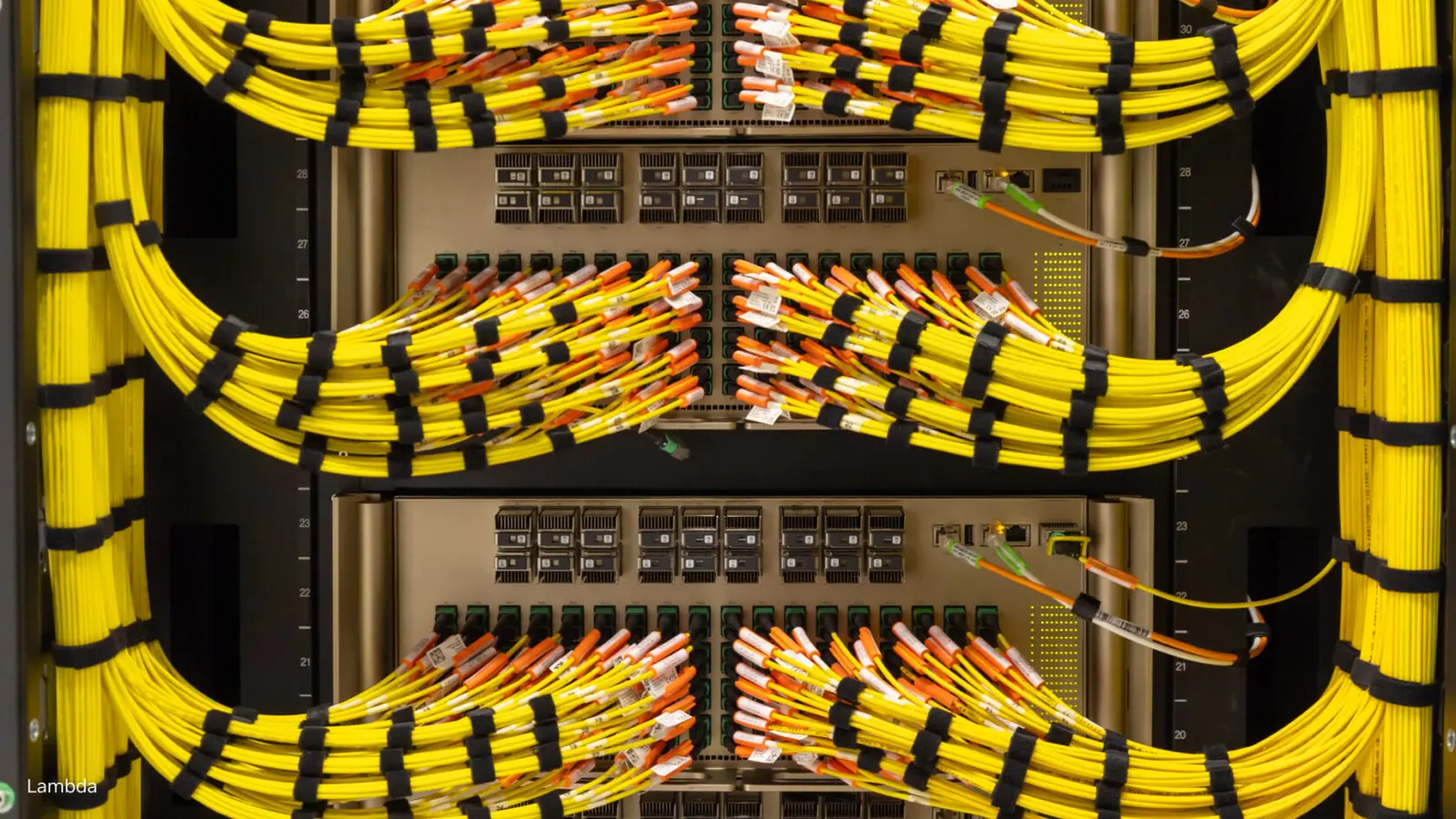
Cloud provider Lambda is using NVIDIA Photonics co-packaged optics (CPO) switches to connect NVIDIA GB300 NVL72 racks holding more than 10,000 GPUs, and NVIDIA says the design brings lower power use, higher resiliency and longer mean time between interruptions to the network of an AI factory. NVIDIA published the details on November 16, 2026, as part of its SC26 announcements.
The network is the part of an AI cluster most people never see. To train a model, thousands of GPUs have to work together, so the links between them must be fast, efficient and resilient. According to NVIDIA, one interrupted link in a large training job can stall thousands of GPUs.
What did Lambda measure?
NVIDIA says Lambda’s tests of the switches showed three things:
- Network latency dropped by about 4% at rack scale and by up to about 10% at pod scale.
- Throughput stayed the same as conventional pluggable optics across rack, scalable unit and pod configurations.
- Lambda reports a median optics temperature of 36°C, compared with 51°C for conventional pluggable optics, along with more stable signal integrity.
Dave Ward, president of cloud services at Lambda, said: “Networking has to keep pace with the demands of increasingly large AI clusters.”
How do the switches work?
Instead of plugging a transceiver into each port, co-packaging puts the optical engines next to the switch chip on the same package. NVIDIA says that replacing pluggable transceivers this way delivers up to 5x better power efficiency and up to 15x higher reliability than conventional pluggable optics, and that it uses 4x fewer lasers, which means fewer parts that can fail.
The details NVIDIA gives for Lambda’s deployment:
- Each switch has 144 ports running at 800Gb/s.
- Liquid cooling carries heat away from the switch chip and the optical engines.
- Each switch has 18 removable external light sources that feed the optical engines, and technicians can replace those modules in the field instead of swapping a whole transceiver when a laser fails.
- Co-packaging shortens the electrical path from inches to millimeters and removes the need for retimer chips, which cuts power draw and the number of parts in the signal path.
What do Lambda’s own numbers say about power?
Lambda wrote about an earlier engineering sample of an NVIDIA Quantum-X Photonics switch on June 1, 2026. That switch, the Q3450-LD, is a 4U unit with 115.2 Tb/s of non-blocking switching capacity and lists the same 144 ports at 800G and 18 removable light-source modules.
Lambda put its power at 3.95 kW, against 7.0 kW for a standard switch, a saving of 3.05 kW per switch. For a GB300 NVL72 cluster of 10,368 GPUs it counted 216 CPO switches and 658 kW of network power freed, the equivalent of 470 extra GPUs.
Lambda adds a caution: CPO does not automatically increase the number of deployable GPUs, because rack layout, cooling and power distribution decide how those watts are used. It also says a 128,000-GPU data center with traditional pluggable transceivers needs roughly 655,000 transceiver modules, each one a possible failure point, and that the back-end fabric accounts for 86% of networking power in a three-layer cluster at this scale.
How much does it cost?
Neither NVIDIA’s post nor Lambda’s write up lists a price for the switches or for Lambda’s GPU capacity. Pricing and availability are questions for NVIDIA and Lambda directly.
Who it suits
AI infrastructure and data center planners. The power, temperature and reliability figures are the useful part, because they show what the network layer costs in watts and in interruptions at more than 10,000 GPUs.
Teams that rent GPU capacity. Lambda is a cloud provider, and fewer network interruptions matter most to long jobs. The sources do not say whether customers see any change in service or price.
Operators of much smaller clusters. The figures here come from a deployment of more than 10,000 GPUs, so they should not be read as a promise for a handful of racks.
Anyone who wants independent numbers. Every measurement above comes from NVIDIA or Lambda. Neither source includes an outside test, so treat the percentages as vendor reported.
What is still unknown?
The sources do not name the site, say how many Lambda customers use the cluster, or give a date for general availability of the switches. NVIDIA and Lambda also do not publish a power figure for this exact deployment.
For the full technical detail, read NVIDIA’s blog post on the Lambda deployment and Lambda’s own write up of the Quantum-X Photonics switch.