Google Labs has introduced Stitch Loop, an experimental long-running agent that connects to a team’s codebase and live product metrics and keeps working on improvements after software ships. Google opened the waitlist on Nov 18, 2026, for all users globally, with eligible Google AI Ultra users getting priority access.
Google presents it as the next step after coding agents, whose job, in its words, ends the moment a pull request merges. Stitch Loop is meant to cover the work that follows: patching vulnerabilities, speeding up checkout and making sense of sign-up drop-offs buried in noisy feedback. Google says the target is lean teams.
What is Stitch Loop?
Stitch Loop is a new experiment from Google Labs, built on Stitch, the tool Google says millions of designers, developers and founders already use to turn ideas into working interfaces. For background, The Register reported in March 2026 that Google had redesigned Stitch with an infinite canvas and a design agent, and had released an SDK and MCP server so it could link to coding assistants.
Here is what Google says the new agent does:
- Connects to GitHub and your product context, such as logs, user behavior and feedback
- Pulls that context in through over 180 integrations, custom MCP servers or local CLI uploads
- Runs evergreen loops that aim at measurable outcomes you choose
- Keeps working around the clock until your goal is met, then keeps watching in case the metric slips
How does a loop work?
Each loop moves through four steps, according to Google.
- Suggestions: the agent surfaces opportunities to progress toward your goals, backed by evidence from your product.
- Solutions: every suggestion comes with one or more solutions, each with tradeoffs and scoping, plus visual design options where they apply.
- Build: after you pick a direction, it writes the code in an isolated cloud sandbox and opens a GitHub pull request. Where relevant, the pull request includes screenshots and videos of the work.
- Reflect: it monitors live product data as it works and learns from each positive or negative result to sharpen the next round of insights.
Google is clear about control: “You always have the final call.” Nothing merges until you review the pull request.
Which loops come built in?
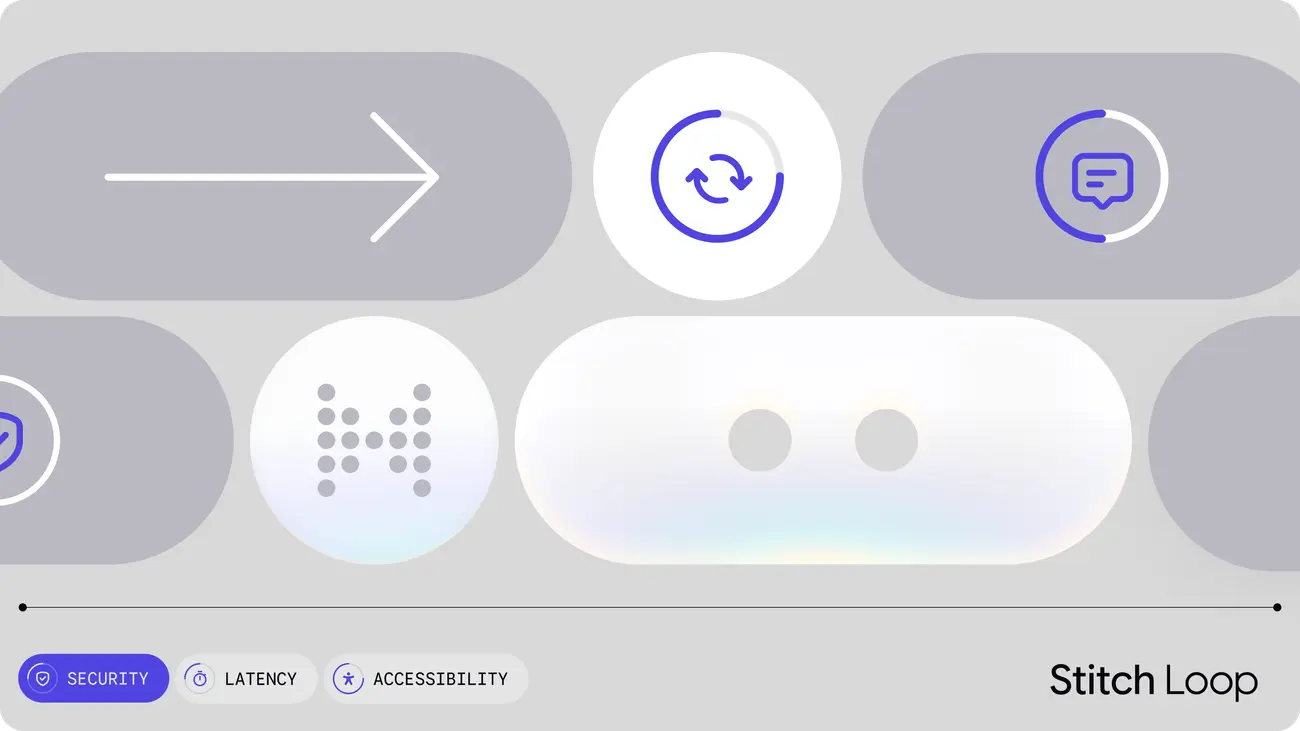
Three default loops ship out of the box: security, latency and accessibility. You can add your own at any time, and Google gives improving checkout conversion as an example of a custom loop.
The security loop gets the most detail. Google says it pairs the cyber security capabilities of Gemini 4 Carbon with CodeMender, an autonomous agent from Google DeepMind that improves code security. Together they scan a codebase for vulnerabilities before they become incidents. The agent flags each issue with evidence and opens a pull request with a proposed fix for review. Google gave no further detail on how the latency and accessibility loops work.
Can it work with other coding agents and Slack?
Yes, according to Google. Stitch Loop can act as a service layer for coding agents such as Google Antigravity. Whatever coding agent a team prefers can pull persistent product context from Stitch Loop through the Stitch CLI and MCP, which Google says supports mixed-model setups and fully autonomous improvements inside an existing workflow.
In Slack, typing @stitch gives daily insight digests and lets you create new loops.
How much does it cost?
Google lists no price for Stitch Loop. The only access detail is the waitlist at stitch.google.com/loop/waitlist, which is open to all users worldwide, with priority for eligible Google AI Ultra users. Google does not say here what makes a Google AI Ultra user eligible, when invitations will go out or whether the agent will be paid once the experiment moves on.
Who does it suit?
Small product teams. If a handful of people ship fast and rarely get time to chase performance, security and accessibility fixes, a loop that proposes evidence-backed changes could take on some of that routine work. Every change still lands as a pull request your team reviews.
Developers who already use coding agents. The Stitch CLI and MCP route lets an existing agent draw on product context, so you do not have to change tools to try it.
Founders and product leads. The goal-first design, where you set a measurable outcome and review options with tradeoffs, fits people who want to steer priorities without reading every line of code.
Who should wait. Anyone who needs a price, a service commitment or a firm date should hold off. This is labeled an experiment, access is by waitlist, and Google has not published terms.
What is still unknown?
Google has not said when waitlisted users will get access, how many people will be admitted first, what eligibility means for Google AI Ultra users, or what the service will cost. It also has not shared results from real teams, so claims about quality and speed come from Google alone.
What to do next
If you want to try it, join the waitlist at stitch.google.com/loop/waitlist and share feedback in the Google Labs Discord, as Google suggests. Before connecting a real codebase, decide which repository and which metrics you would expose, and keep your normal pull request review rules in place.