Tabletop is a new Google Labs experiment that gives a group one shared online space where everyone can plan, vote and build together at the same time. Google announced it on November 11, 2026, and it is rolling out in the U.S. for users aged 18 and over through a waitlist.
The idea is aimed at the everyday coordination that usually gets scattered across chats, spreadsheets and documents: a family trip, a rec league, a potluck. Google compares the experience to working in a Google Doc, but with interactive tools instead of plain text.
What is Tabletop and how does it work?
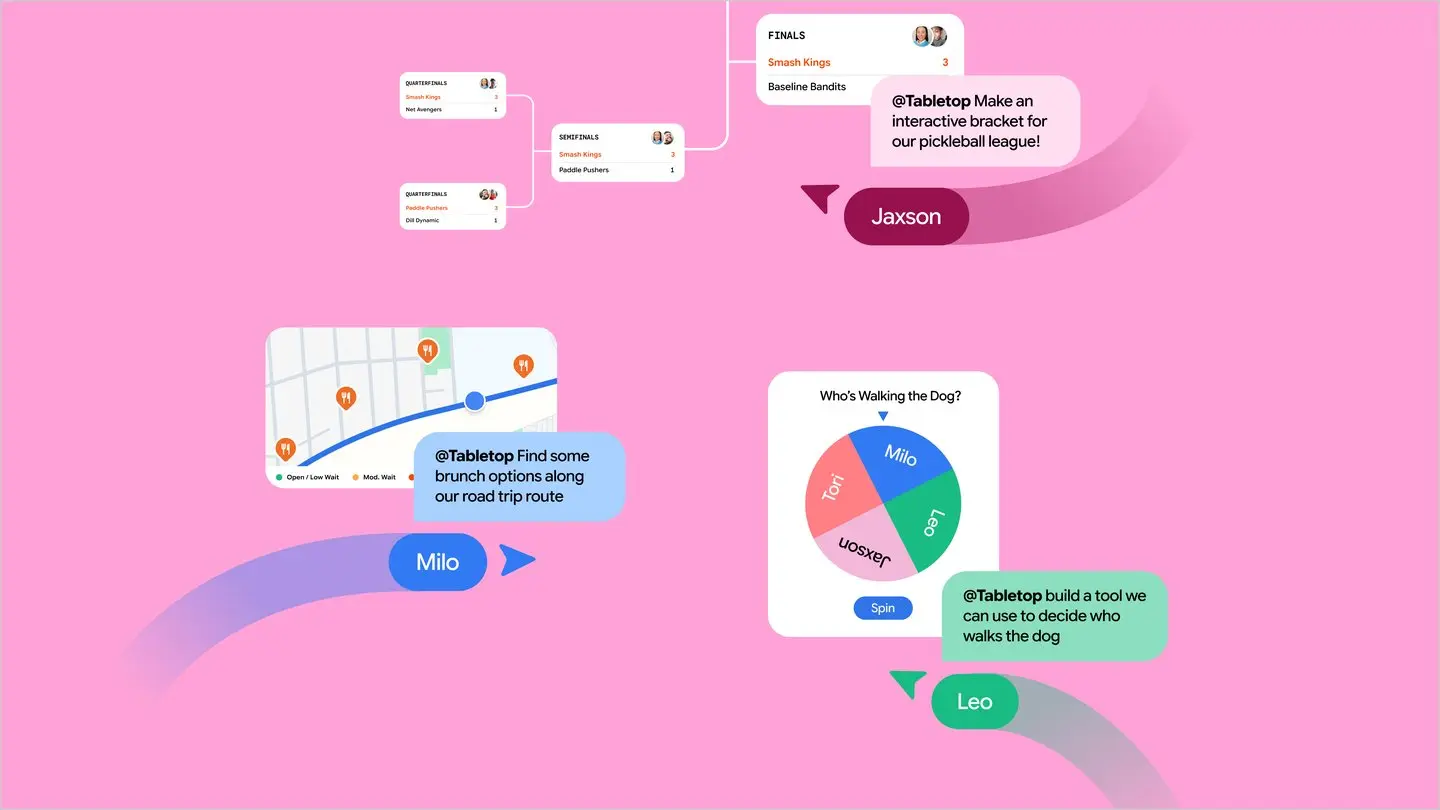
You start a space and add your links, files and ideas. Then you either prompt @tabletop or pick a starter template, and Tabletop generates a custom interactive tool from what is in the space. Google’s examples:
- Trip itineraries
- Dinner polls
- Expense splitters
- Tournament brackets
Once the space is ready, the organizer drops an invite link into the group chat. Everyone who joins can use the same space at once, in real time, the way several people edit one Google Doc together.
Coverage of the launch by the outlet Coruzant adds a few details from early demos. Tools can be changed with follow-up requests, and one demo reworked an office party seating chart so name badges could be dragged between tables. That detail comes from the outlet’s account, not from Google’s own announcement.
Who can try Tabletop, and when?
Access is limited and staged. Google says Tabletop is rolling out in the U.S. for people 18 or older, and you join through a waitlist at labs.google/tabletop. Coruzant reports that Google plans to let more people in each week. Pulse2, another outlet that covered the launch, notes that Google has not announced a general availability date or any plan for countries outside the U.S.
What would you use it for?
The announcement gives three situations, and the examples map neatly onto them.
- A family trip: collect booking links and ideas, then ask for an itinerary everyone can see.
- A rec league: ask for a bracket and update it as games finish.
- A potluck or dinner: run a poll on dates or dishes, and split costs afterwards.
Because the space lives behind a shared link, nobody needs to copy the latest version out of a chat thread. Whoever has the link works on the same thing.
Prices
Google’s announcement does not mention a price, a subscription or a currency for Tabletop. It is an experiment from Google Labs and is currently offered only in the United States, to users aged 18 and over, with access through a waitlist. Pulse2 and Coruzant both report that no pricing has been announced. Availability outside the U.S. has not been stated.
Who it suits
Trip planners in the U.S. If you are the person who ends up building the group’s itinerary, a shared space that generates and updates it from the links and notes everyone adds could save a lot of back and forth.
League organizers and club volunteers. Brackets and schedules are on Google’s list of examples, and a live shared page is easier to keep current than a message thread.
Hosts of potlucks and parties. Polls and expense splitters cover the two questions that most often stall these plans: who is coming and who pays for what.
Readers outside the U.S. or under 18. Nothing in the announcement points to access for you yet, so the realistic move for now is to wait for Google to widen the rollout.
What is still unknown?
Google has not named the AI model behind Tabletop, and the announcement says nothing about pricing or how long the experiment will run. Coruzant points out that privacy handling of personal information in shared spaces is unclear and that the early demos do not show how conflicts are handled when several people edit the same tool at once. If you are in the U.S. and 18 or older, the next step is to join the waitlist at labs.google/tabletop and read Google’s own announcement for updates.