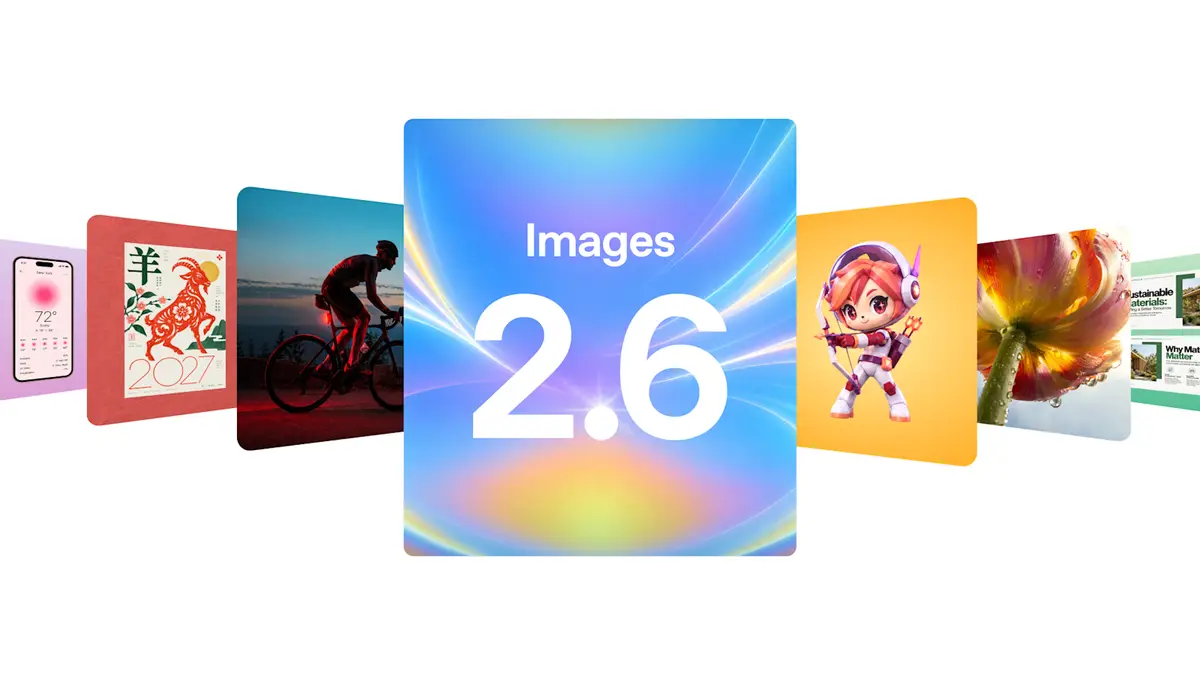
OpenAI has released Images 2.6, an image model that can turn a prompt or photo into a looping GIF and generates images about 50% faster than before. It started rolling out on November 4, 2026 in ChatGPT, Codex and the API, on web, desktop and mobile.
OpenAI says people already create about 4 billion images per week across ChatGPT, Codex and the API, or more than half a billion per day on average. Images 2.6 is aimed at that audience: faster results, animation, and edits that keep a subject looking the same from one round to the next.
What is new in Images 2.6?
The headline addition is GIF creation. In ChatGPT you can describe an animation or start from a still photo, then adjust the playback speed and edit single frames before sharing the loop, according to BetaNews. OpenAI suggests uses such as animating a brand mascot, making social reactions or building an animated storyboard.
The other changes are about control:
- Consistency across edits. The Sunburst model aims for more consistent subjects over several rounds of editing at medium or high quality.
- Layout. OpenAI says the Flare model improves layouts for posters, product imagery and other professional visuals.
- Image markup. Marking up an image to pinpoint an edit is already in ChatGPT and is coming to the API.
- SVG export. Images can be exported as SVG for websites, apps and print.
- Saved references. BetaNews reports that ChatGPT can keep reference pictures of a person, pet or recurring character so you do not have to upload them again.
How fast is it?
OpenAI says output is about 50% faster than before. Flare can finish in as little as six seconds when quality is set to low. That figure is OpenAI’s own claim for the low quality setting, and the launch page does not say how it was measured.
How do the API models differ?
Developers get two models, GPT-Image-2.6 Flare and GPT-Image-2.6 Sunburst. Flare is the speed option and suits posters and product shots. Sunburst is the detail option, with greater consistency across edits, image annotation to guide changes and SVG export.
The API also gains a complexity parameter that controls how much planning the model does. OpenAI says low suits quick edits, while medium or high suits scenes with many elements or constraints. A separate image quality parameter controls visual detail and fidelity.
Who can use it, and what does it cost?
Images 2.6 is rolling out globally in ChatGPT and Codex across all subscription tiers. The API models are available to developers.
The launch page lists no prices and links to OpenAI’s developer pricing documentation for image generation. Check that page for current API rates, because API billing is separate from a ChatGPT subscription plan.
OpenAI describes safety evaluations and safeguards in a linked system card. Model cards are in the developer docs.
Who it suits
Social and marketing teams. GIF creation covers mascots and reaction clips, and Flare targets layouts for posters and product imagery.
Designers and brand owners. Sunburst is the model OpenAI points to when a character, product or brand detail needs to survive several edits.
Developers. The complexity and quality parameters, markup edits and SVG export give more control over cost, speed and output.
Who should wait. If you need a published price before you commit, or you have not seen how GIF creation handles your own subjects, wait for the pricing page and try a few prompts first. OpenAI’s partners, including OpenArt, Figma Weave and Picsart, report good early results, but those are the company’s launch partners.
What is still unknown?
The launch page gives no API prices, no limits on GIF length or size, and no timing for when every account will see GIF creation. The speed claims and the early partner comments are OpenAI’s own, so treat them as claims until you try the model on your own work.
Read OpenAI’s Images 2.6 post and the developer pricing docs to see the exact API options before you build on it.