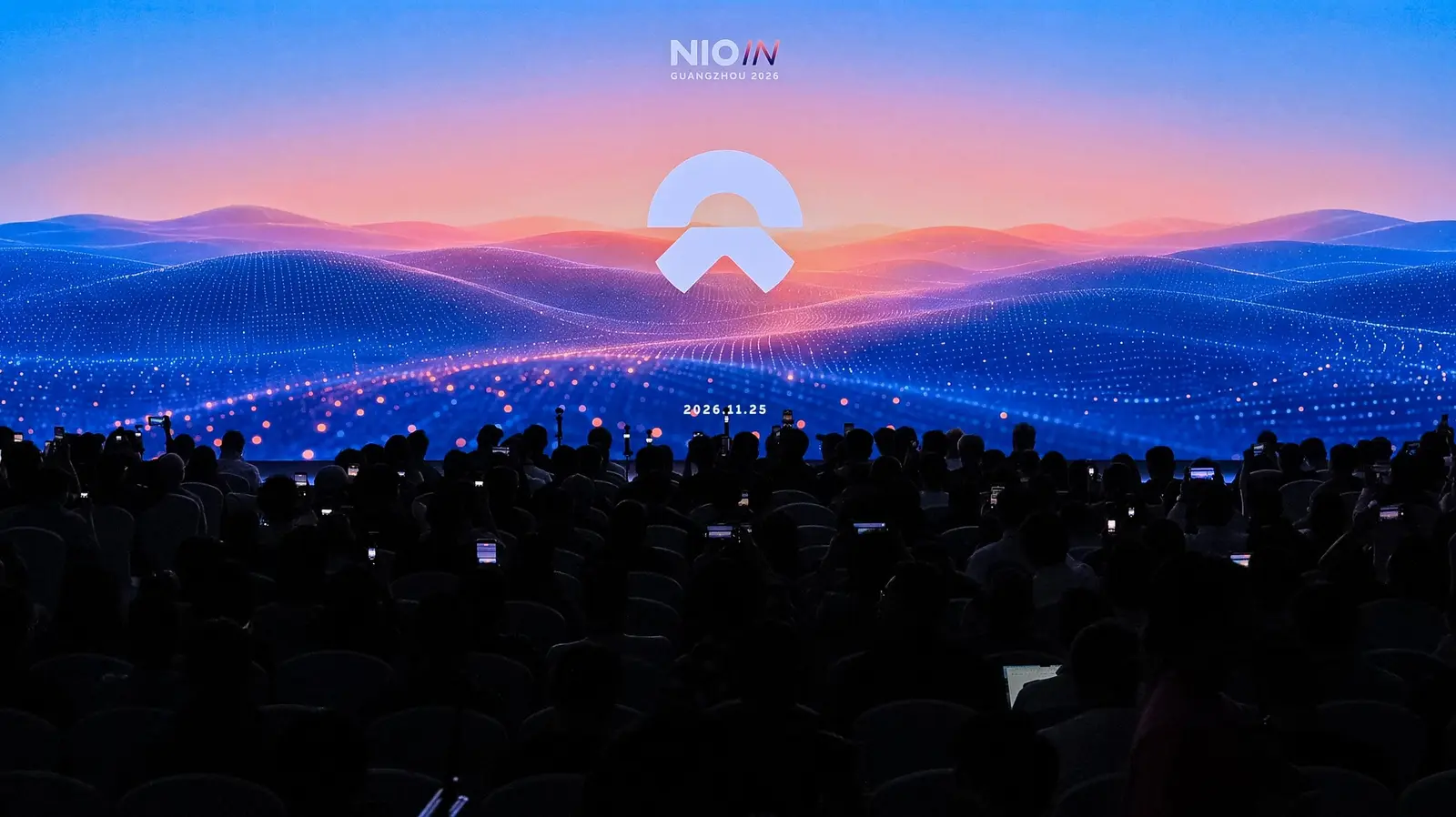
NIO has unveiled two AI systems for its cars: NWM 3.0, a driving model that it says needs 40% fewer driver interventions than the last generation, and NOMI Intelligence 4.0, an in-car assistant built to carry out tasks on its own. The company announced both on November 25, 2026 at NIO IN, its third innovation and technology event, held in Guangzhou, China.
NIO says NWM 3.0 reaches existing owners first, with a December start. The cabin assistant follows in phases that run into 2027.
What is NIO WorldModel 3.0?
NIO WorldModel (NWM) is the model behind the company’s smart driving. It first appeared in July 2024 and has now been through three iterations. NIO calls version 3.0 its latest step in scaling physical intelligence for smart driving.
The figures NIO published:
- A 36-fold reduction in the onboard computing resources needed for attention, using 4D spatiotemporal compression
- Chassis control latency down by 78%
- Overall vehicle control latency down by 54%
- Training efficiency five times that of the predecessor
- 40% fewer driver interventions than the previous generation, with users’ sense of reassurance up by around 60%
Those are all NIO’s own claims, and the company did not say how the intervention and reassurance numbers were measured. Shaoqing Ren, NIO’s Senior Vice President and Head of Autonomous Driving Development, presented the model.
On training, NIO describes a reinforcement learning setup with two closed loops, one in observation space and one in latent space. The latent loop updates the model’s picture of the world faster and with fewer resources, while the observation loop rebuilds sensor data to make closed-loop testing more reliable. NWM 3.0 also adds a reward model for judging driving in real conditions.
What is NOMI Intelligence 4.0?
NOMI is NIO’s in-car assistant, and version 4.0 changes how it works. Instead of running commands through fixed workflows, NIO says it now combines its own foundation models, a native AI agent framework, the underlying vehicle infrastructure and a vehicle-wide safety framework.
According to NIO, NOMI can sense what is happening inside and outside the car, use tools across vehicle systems, work out what the user wants, plan steps and finish the task toward a goal. Ted Li, NIO’s Senior Vice President of Product Experience, described it as the industry’s first vehicle-native intelligent agent framework. That is the company’s description, not an independent ranking.
When does it roll out?
NIO set different timing for each system:
- NWM 3.0: from December, for all users of Banyan, Cedar, Cedar S and Coconut+ smart systems, after regulatory filing and clearance
- NOMI Intelligence 4.0 on Cedar 2.0.0: filing in early December, with the rollout starting after clearance
- Cedar S and Banyan models: expected in the second quarter of 2027, after system adaptation
- Coconut and Coconut+ systems of ONVO models: later, with no date given
How is NIO using AI inside the company?
William Li, NIO’s founder, chairman and CEO, said smart electric vehicles are the most valuable form of physical AI and that carmakers need to become AI-native organizations themselves. NIO says it has deployed more than 7,500 AI agents across R&D, manufacturing, logistics and user services, with over 2.9 million executions so far.
For its energy business, NIO Power, the company expects by 2030 to manage more than RMB 350 billion in battery assets, operate over 10,000 Power Swap Stations and deliver more than 10 billion kWh of energy a year. Those are targets, not results.
Prices
NIO did not list prices for NWM 3.0 or NOMI Intelligence 4.0 in its announcement. Both are described as updates for cars and smart systems that already exist, so check the NIO app or your local NIO service channel for whether any feature is optional or paid in your market.
Who it suits
Current NIO and ONVO owners. NWM 3.0 is aimed at cars running Banyan, Cedar, Cedar S and Coconut+, so owners of those systems are first in line. Owners of Cedar S and Banyan models should expect the cabin assistant later, in the second quarter of 2027.
People shopping for a smart EV. The announcement is about software, so it will not change a car’s hardware. It does show where NIO is putting effort: driving assistance that reacts faster and a cabin assistant that can act on goals.
Readers following AI in cars. The claims on latency, compute and driver interventions are worth comparing with what other makers publish, keeping in mind that each company measures them its own way.
Who should wait. Both rollouts depend on regulatory filing and clearance, which are not guaranteed to match the planned dates in every market. Anyone deciding on a car for these features alone should wait for the actual release notes.
What is still unknown
NIO did not say which countries get each update first, whether the new assistant needs specific hardware, or how it measured the 40% and 60% figures. It also gave no date for the ONVO Coconut systems. The full release is on NIO’s newsroom, and the Guangzhou Auto Show opens on November 27, where more NIO news may follow.