Google has published five projects that builders made with Gemini 4 Carbon, its model for tasks that push the limits of a model’s intelligence. They range from a wind-swept meadow to a simulated 19th-century optics lab, and they all sit behind a paid door: Carbon is not part of the free Gemini tier.
The post is dated Nov 17, 2026 and was written by contributor Kimberly Fusaro. Google says that since it rolled Carbon out more broadly last week, the community has leaned into its ability to explore thoroughly, reason deeply and run extended verification loops.
What did the five builders make?
Each project comes from a creator on X, and Google’s post includes a video for every one:
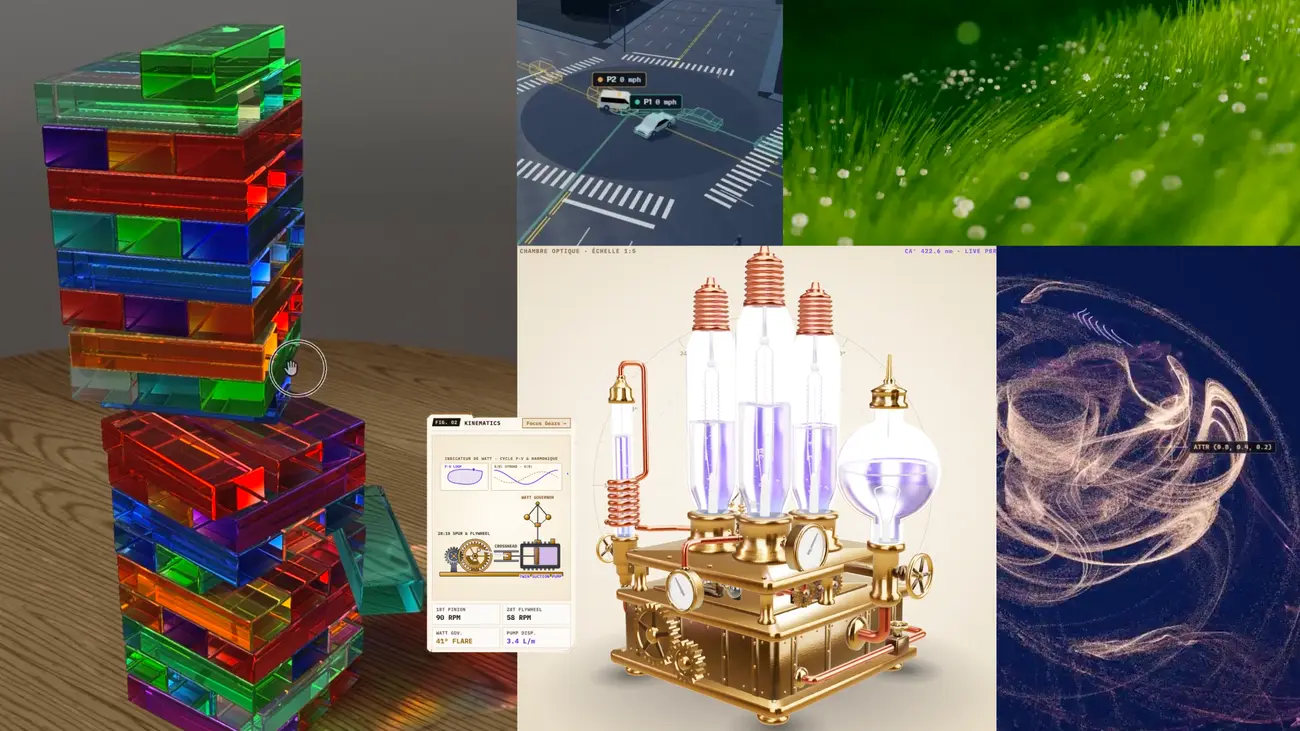
- Glitter Gal: a meadow of 52,000 wildflowers and grass blades coded from scratch in CUDA and C++, with the wind synthesized to match every gust.
- Chubby: a real time simulation of 1,048,576 glowing particles in WebGPU that swirl like tidal currents.
- Andrew V: a block stacking game where every piece is fragile stained glass. Carbon simulated how the tower catches the light, rings when tapped and shatters into shards when it falls.
- Giyu_codes: 14 interactive tools with live 3D visuals, made from scattered public datasets in underserved industries.
- The Bugged Dev: a 19th-century Parisian optics lab built from a single reference image, with 92 brass and glass instruments you can test and tune.
What is Carbon meant for?
Google positions it for the hardest jobs. Digital Trends reported that Google still recommends Gemini 4 Argon for most coding and office work, while Carbon targets harder problems such as complex debugging and open-ended scientific research.
There is a cost to that depth. According to Digital Trends, Carbon uses more tokens than Argon because it explores options and verifies its answers. Mixed News adds that output billing includes thinking tokens, and that Google warns Carbon may use more of them than Argon. In Google Antigravity, an early preview of a /swarm mode splits a request among coordinated agents, and Google cautions that parallel agents can burn through quota faster than a normal chat.
Where can you use it?
Google lists these routes:
- Developers: the Gemini API paid tier in Google AI Studio and Android Studio
- Google AI Ultra subscribers: Google Antigravity, AI Studio, the Gemini app and AI Mode in Search
- Gemini for business users: the API or the model drop down, Google Antigravity, or CodeMender
Digital Trends adds that scientists can apply for six months of free access to Carbon and Argon.
Prices
Google’s post does not list prices. Digital Trends reports that paying developers and businesses pay “$2 per million input tokens and $10 per million output tokens,” which it describes as Argon’s introductory rate. Mixed News says those introductory rates run through November 30, then rise to $4 for input and $20 for output per million tokens. Both outlets quote dollars without naming a country, so check your own billing currency.
No price is listed in the sources for a Google AI Ultra subscription or for Gemini for business seats.
Who it suits
Developers and indie builders. The showcase is aimed at you. If your project needs long verification loops, such as simulations or data pipelines, Carbon is the model Google points to, and the paid API is the way in.
Graphics and simulation fans. The meadow, the particle swirl and the glass tower are demos of physics and rendering work. They show what a prompt can lead to, but the post does not publish the code or the prompts.
Data and analytics people. The 14 tools built from public records show one way to turn messy datasets into something explorable. The thread by Giyu_codes lists all the builds.
Everyone else. If you only use the free Gemini app, you will not see Carbon. Argon remains Google’s recommendation for everyday coding and office work, according to Digital Trends.
What is still unknown
These are showcase projects chosen by Google, so they show best cases, not typical results. The post does not say how many attempts each took, how many tokens they used or what they cost. It also does not give a price for AI Ultra, and the introductory API rate has an end date to watch.
Your next step
Open the five videos in Google’s post to see what each project looks like in motion. If you want to try Carbon yourself, start with a small prompt in Google AI Studio on a paid API plan and watch the token count, since Carbon uses more tokens than Argon and the dollar rates change after November 30.