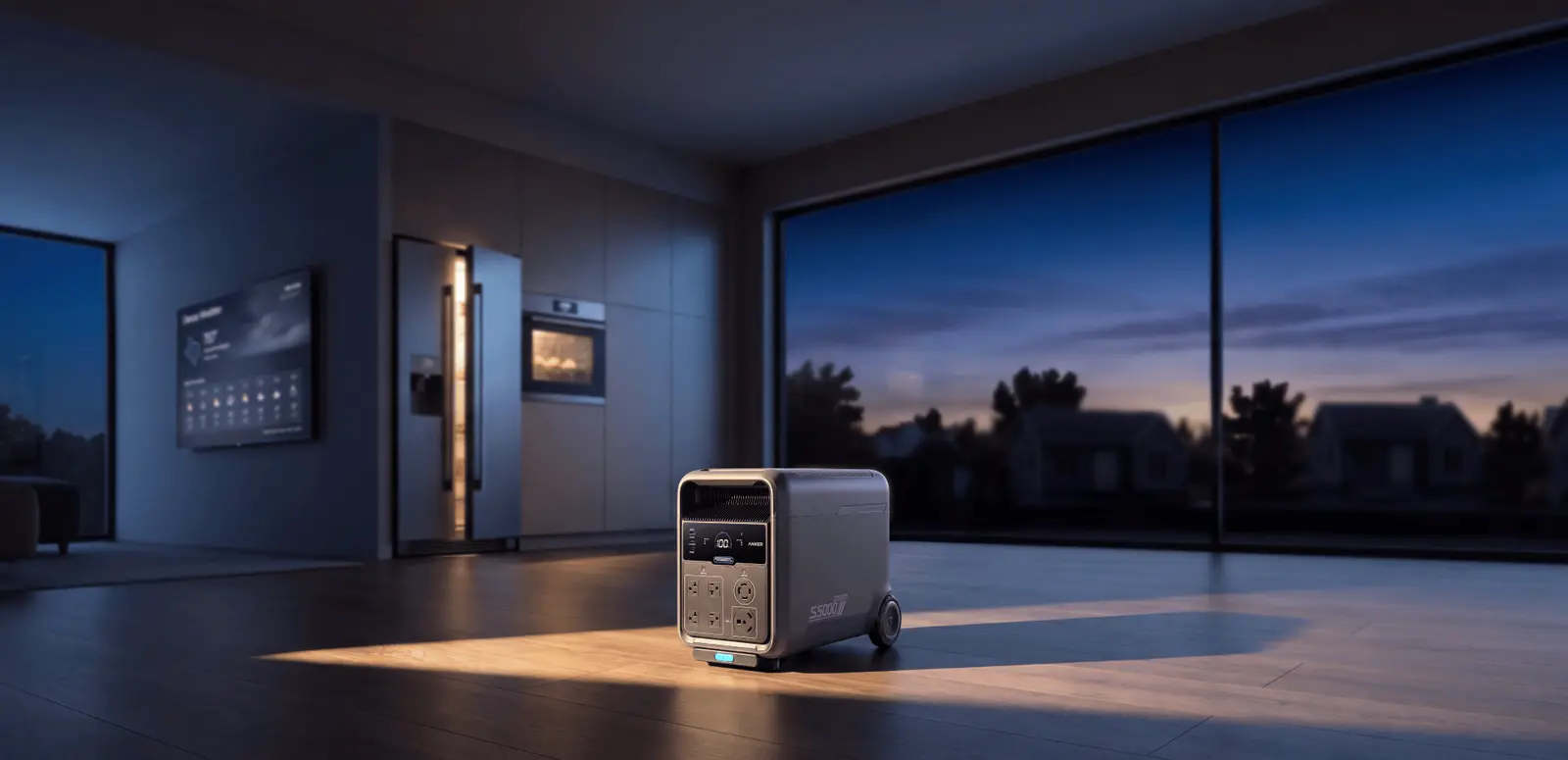
The Anker SOLIX S5000 is a 5,024 Wh portable power station with 4,500 W of rated AC output, and Anker lists it at a launch price of $2,499.99 against a $3,599.99 MSRP in US dollars. Anker’s own page gives a launch date of October 27, 2026, and the model is back in the news ahead of Black Friday promotions.
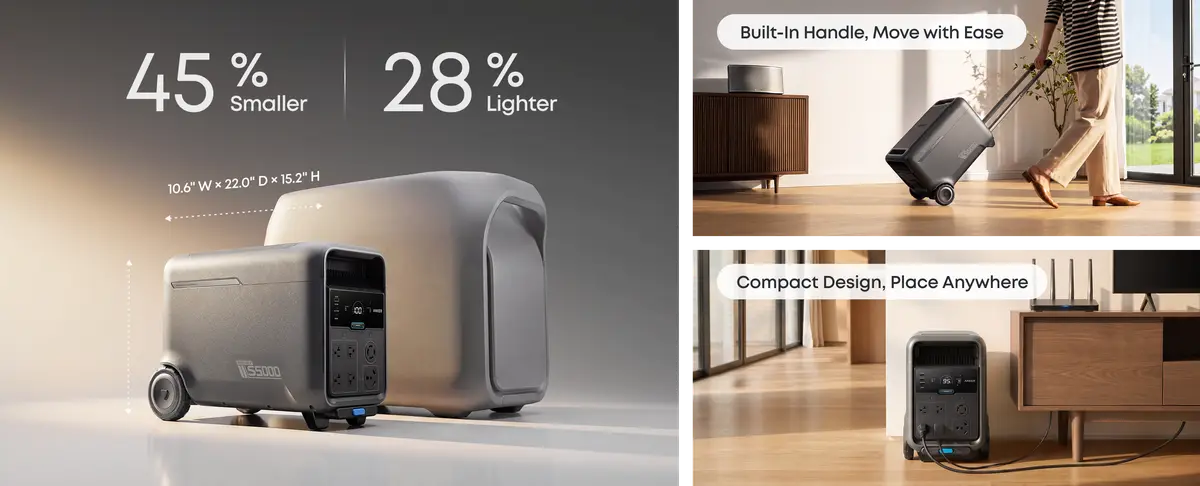
It is a large unit made for home backup, not for a day hike. It weighs 97 lb, runs on LFP cells and expands to 30 kWh with extra batteries, according to Anker.
What is the Anker SOLIX S5000?
It is a battery box with 120 V and 240 V outputs that can keep household circuits running during an outage and recharge from the wall, solar panels, a car alternator or a generator. Anker says it is built with 314Ah LFP cells and carries UL 9540 and UL 9540A certifications.
Specs from Anker’s product page:
- Capacity: 5,024 Wh, expandable to 30 kWh with up to five expansion batteries
- AC output: 4,500 W rated, 8,000 W peak, dual 120 V and 240 V
- AC ports: NEMA 5-20R, L14-30R and TT-30R
- USB-C2: 100 W maximum
- Switchover time for backup use: 10 ms or less
- Battery life: rated for 10,000 cycles, with a stated lifespan of 15 years
- Size and weight: 10.6 x 22.0 x 15.2 in, 97 lb, with wheels and a pull handle
- Noise: 30 dB
- Standard warranty: 5 years
How fast does it charge?
Anker says a full charge from 0 to 100% takes about 99 minutes. The page lists several input routes:
- AC wall power: 1,800 W at 120 V, or 4,500 W at 240 V
- Solar: up to 3,000 W through two inputs (1,000 W and 2,000 W)
- Car alternator charger: 800 W
- Anker SOLIX smart generator or a third-party generator: 4,500 W each
Anker adds that the unit discharges from -20°C to 40°C and charges from 0°C to 40°C. That matters if you plan to keep it in an unheated garage in winter.
How much does it cost?
Prices below are in US dollars from Anker’s page and from SlashGear:
| Item | Price (USD) |
|---|---|
| MSRP | $3,599.99 |
| Launch price | $2,499.99 |
The launch price is $1,100 below MSRP. Anker also described a bonus package worth up to $699 for people who signed up before launch, with a two-year warranty extension, an Anker Prime charging station and a 240 V charging cable. SlashGear reported on November 5, 2026 that the launch period ended on November 9, 2026, with gifts to be redeemed by November 15, 2026.
Anker’s S5000 page now points to Black Friday promotions from November 10 to 18, but the product page itself shows no fixed price. Check the live listing before you decide. Anker does not state prices for other countries on the pages we read.
What does Anker say it can run?
SlashGear reported that Anker claims the S5000 can power a home for 48 hours. The report gives no load assumptions, so treat the figure as a marketing claim and not as a promise for your house. Real runtime depends on what you plug in.
Who it suits
Homeowners in outage-prone areas. The 240 V output, 4,500 W rating and 10 ms switchover are aimed at running essential circuits and appliances during an outage.
People with solar panels. Anker lists up to 3,000 W of solar input, and the system can grow to 30 kWh later.
Workshop and job site users. The wheels and handle help, but at 97 lb this is a unit you move rarely.
Who should wait. If you want something to carry to a campsite, 97 lb is a lot. If you need to charge below 0°C, the stated charging range starts at 0°C. Anyone who wants a firm price should wait to see what the live listing shows after the launch period.
What is still unknown?
The page does not publish a price outside the launch figures, nor does it list prices for other countries. The 48 hour claim comes without a stated load. Anker has not said how long the launch pricing or the November promotions will continue beyond the dates reported.
What should you do next?
Open Anker’s S5000 page, read the current price and the bundle you want (the unit alone, with one extra battery, with five, or with a generator), and compare that with the figures above. Before you buy, check your electrician’s advice on how to connect a battery to your home wiring.