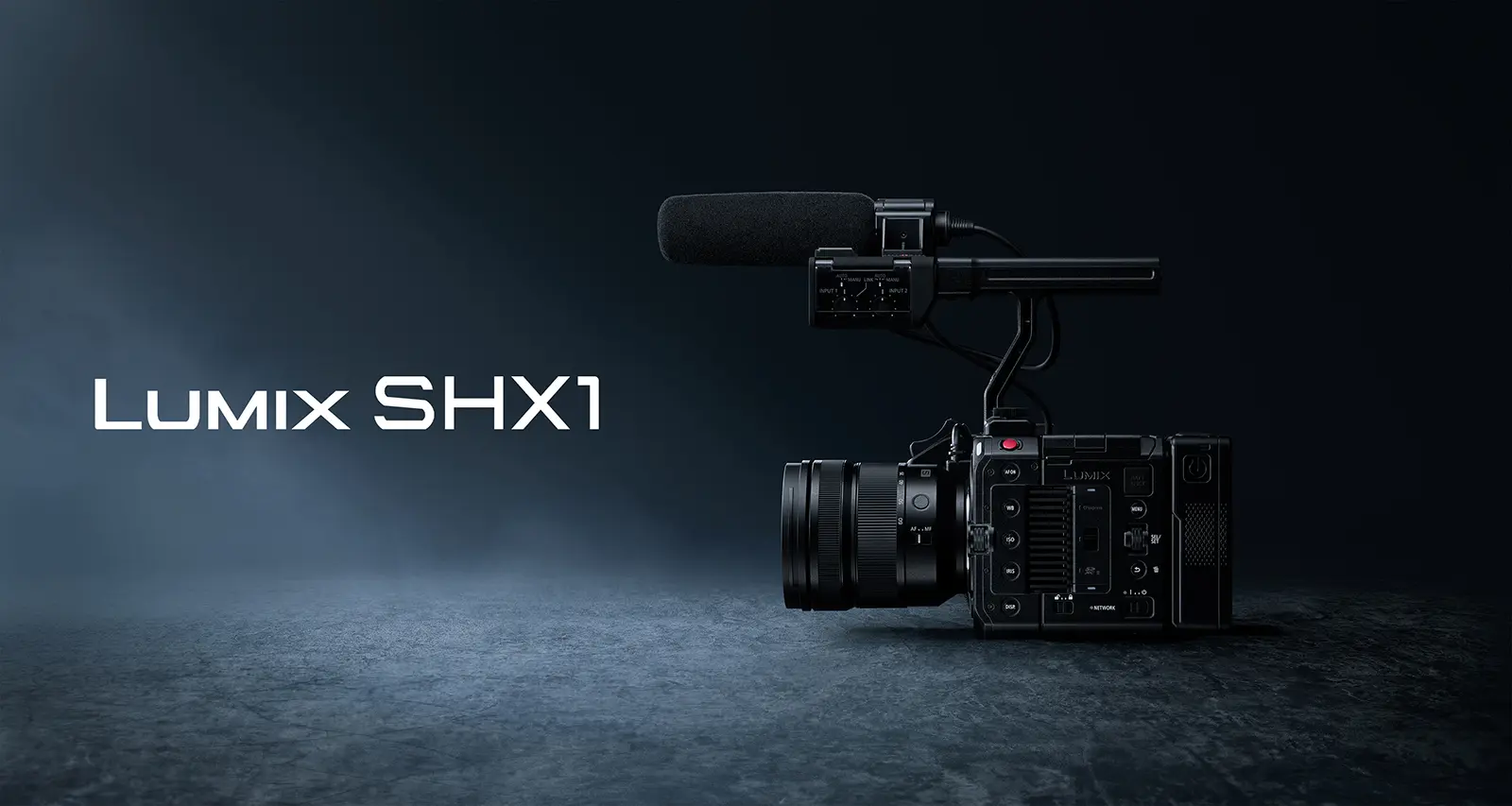
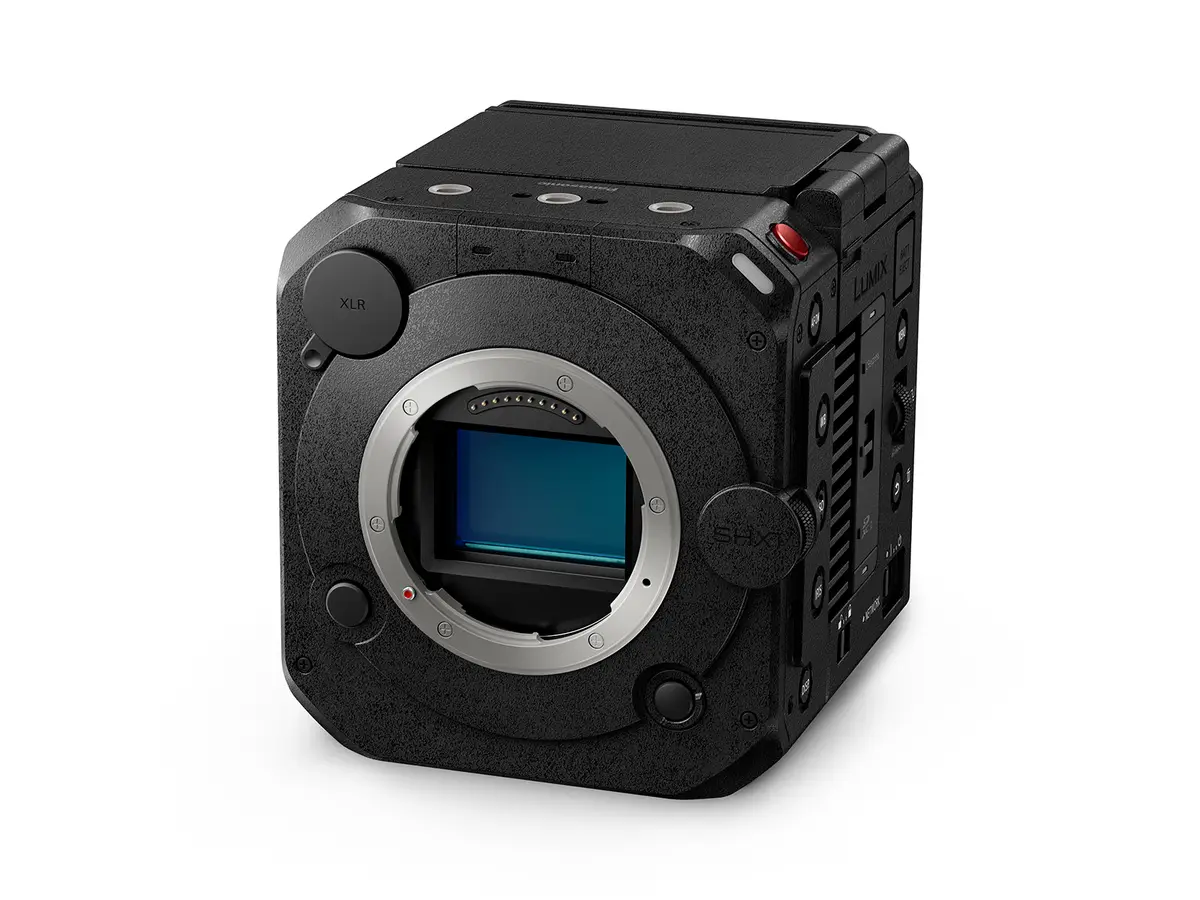
Panasonic has announced the LUMIX SHX1 (AU-SHX1), which it calls the first compact cinema camera in LUMIX history. It pairs a 6K full-frame sensor of about 24.1MP with a box-style body that weighs about 984 g, and Panasonic’s global release says it will be available in stages from December 2026.
No price comes with the announcement. The global release says pricing and availability vary by country and region, while the Japanese release lists an open price and a late January 2027 date.
What sensor and image quality does it offer?
The SHX1 uses a 6K full-frame partially stacked CMOS sensor with an optical low-pass filter, which Panasonic says reduces moire and false color. Dual Native ISO with Dynamic Range Boost is built in.
- Dynamic range of 15 stops in V-Log/V-Gamut with Boost on, and 14+ stops with Boost off
- ARRI LogC3 pre-installed, alongside V-Log and selectable Blackmagic color science
- Phase Hybrid autofocus with 779 focus points, covering people, animals, cars, motorcycles, bicycles, airplanes and trains
- 5-axis body stabilization, plus Dual I.S. 2 that combines camera and lens stabilization at telephoto
Panasonic notes that turning Boost on lowers video quality and ISO limits and increases rolling shutter distortion.
Which recording formats are supported?
| Format | Details |
|---|---|
| Blackmagic RAW | 6K 24p Open Gate with a slight crop, a first for LUMIX |
| Standard video | 6K 30p and 5.1K 60p (4:2:0 10-bit, 3:2 Open Gate), 3.8K 48p (4:2:2 10-bit) |
| High frame rate | 4K 120p with no time limit within the guaranteed operating temperature range |
| Apple ProRes RAW HQ and ProRes RAW | Recorded internally to CFexpress Type B |
| Blackmagic RAW to SSD | Recorded directly to an external USB-C SSD up to 2TB |
What about the body, ports and power?
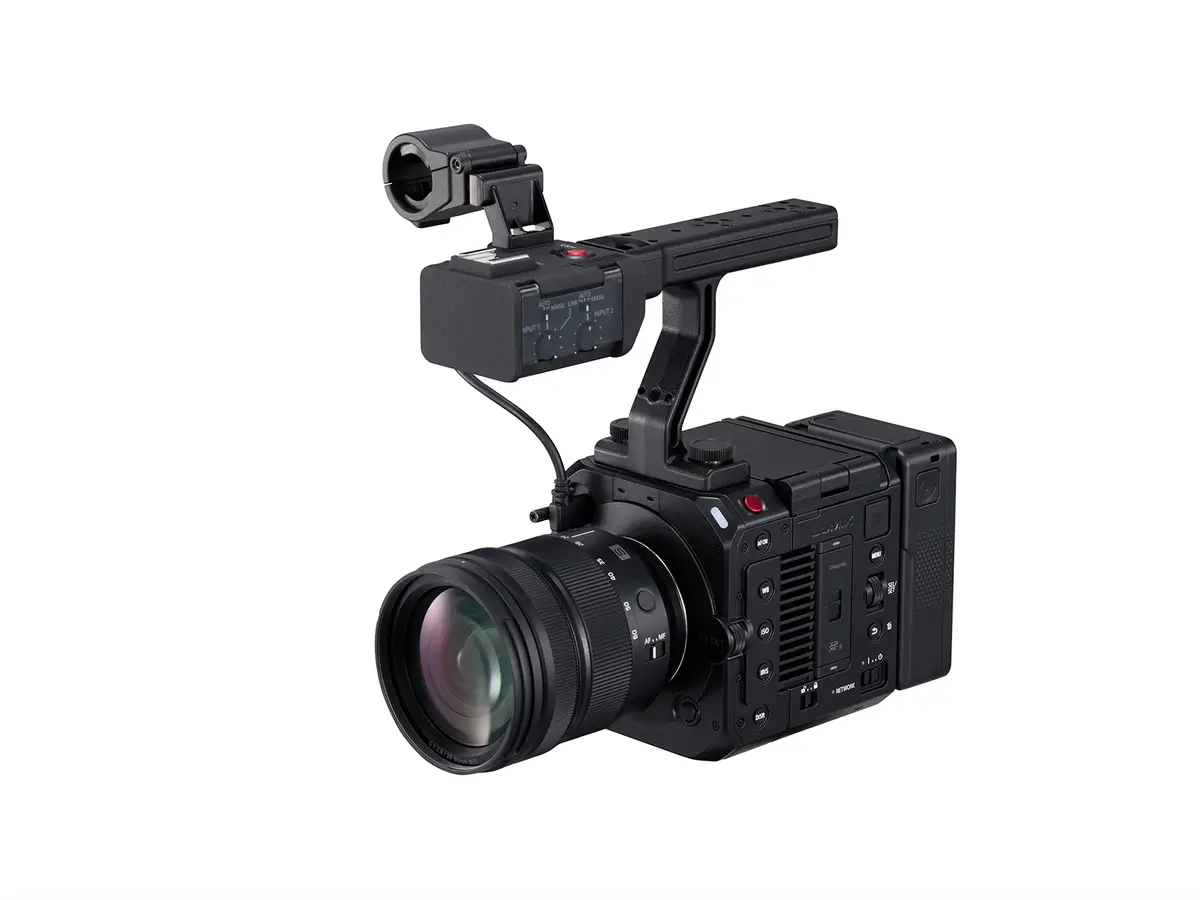
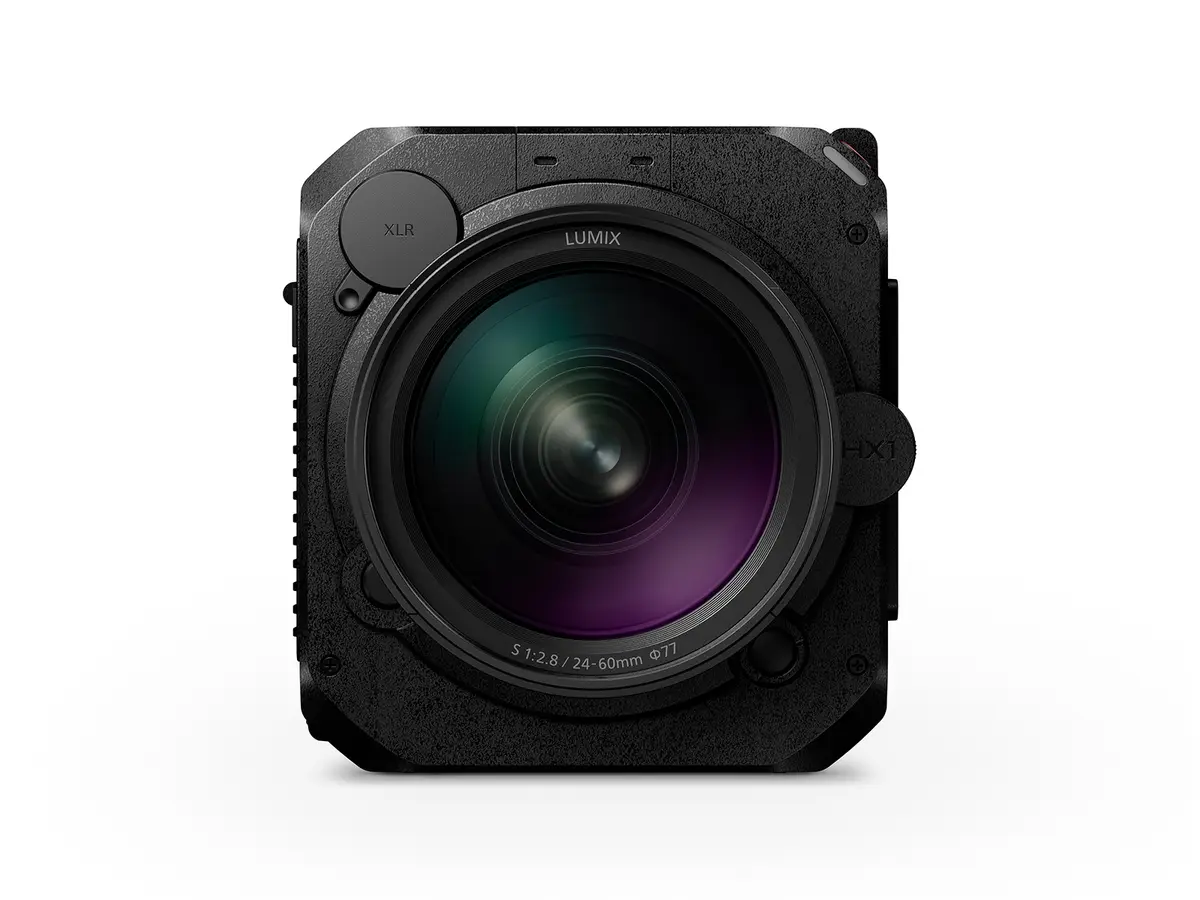
The frame is aluminum and magnesium alloy, and the top-mounted 3.0-inch tilt monitor has about 1.84 million dots. The camera has dual card slots for CFexpress Type B and SD, a 12G-SDI output up to 4K 60p, an HDMI Type A output, BNC timecode in and out, and a 3.5mm microphone input with internal 32-bit float audio recording.
It is also the first LUMIX with Micro V-mount battery support, which can power the camera and its accessories. Two locking USB Type-C ports handle an SSD or smartphone on one side and USB Power Delivery on the other, and Panasonic says power delivery needs an adapter and cable rated for 100W+ (5 A/20 V).
Which accessories and apps are announced?
- XLR Handle Unit AU-XHU1: four-channel 32-bit float audio, high-resolution audio at 96kHz/24bit
- Control Grip AU-GRP1: white balance, ISO and iris buttons, a joystick and a power zoom rocker
- Live Production Unit AU-LPU1: first half of CY2027, with Genlock IN and PoE++ LAN for PTZ use
- A firmware update in the first half of CY2027 adds Tilta Mirage Variable ND control
LUMIX Flow v1.8.0 and LUMIX Lab v3.2.0 add SHX1 support and support for iOS 27 and Android 17. A power zoom lens is in development with no date.
Prices
Panasonic’s global release gives no price. The Japanese release lists the AU-SHX1 body at an open price, with no yen amount, and it does not list a price for the AU-SHX1U kit. No other currency or country price has been stated.
Who it suits
Independent filmmakers and small crews get internal RAW options, a compact box body and two card slots, which suits shoots where a full cinema rig is too large.
Run-and-gun and documentary shooters can rely on the 5-axis stabilization, 779-point autofocus tracking and Micro V-mount power, though the Control Grip AU-GRP1 is an optional accessory.
Live and broadcast teams will find 12G-SDI, timecode, Bluetooth timecode sync and a planned Live Production Unit in the first half of CY2027, which is still months away.
Photographers curious about video should note that this is a cinema-style body, so the accessories list matters as much as the sensor.
Some things are still unknown: the price, the exact markets, what the AU-SHX1U kit includes, and the date for the power zoom lens. The two releases also differ on timing, with December 2026 in stages globally and late January 2027 in Japan, which Panasonic says may slip. Check Panasonic’s LUMIX website for the confirmed date and your country’s pricing.